
What Is a Miniature Bearing? Understanding P4 Precision and High-Speed Ratings
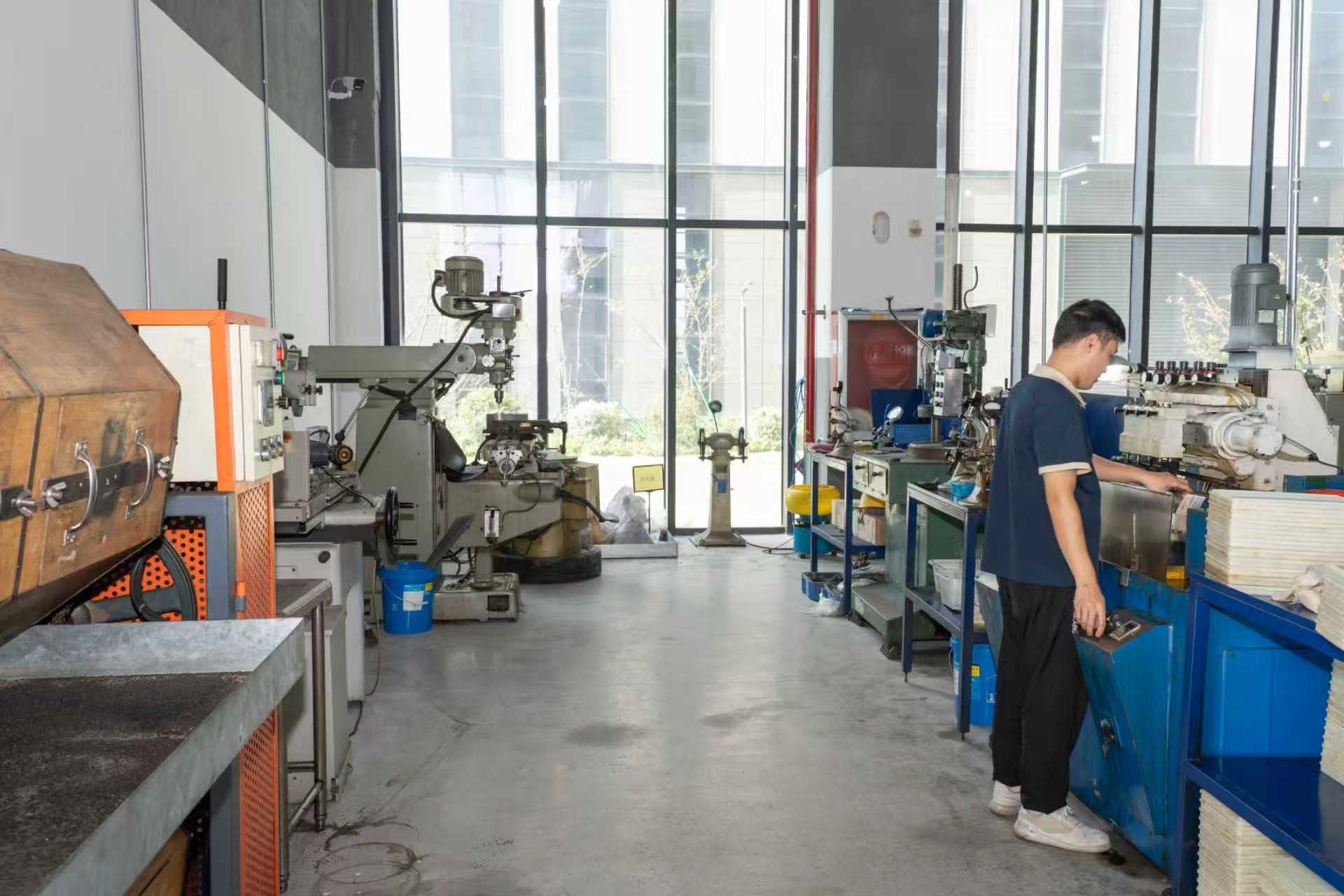
Worker operating machining equipment in the modern LNB-BRG manufacturing workshop.
A miniature bearing is a small precision rolling bearing built to carry a shaft inside a compact assembly — a dental handpiece, a micro-motor, or a hand-held medical instrument. Two numbers decide whether a specific miniature bearing will survive in that assembly: its precision class and its limiting speed. INB produces high-precision standard bearings with bore diameters from 2 mm to 8 mm in precision grades P6 to P4, and the smallest dental-handpiece models in the range start at a 2.38 mm bore. The gap between a 200,000 rpm rating and a 350,000–400,000 rpm rating is not a marketing difference; it reflects measurable differences in material, internal geometry, lubrication and heat path.
What Is a Miniature Bearing?
Mechanically, a miniature bearing belongs to the same product family as any other rolling-element bearing: an inner ring, an outer ring, a set of rolling balls, a cage that keeps the balls separated, and a shield or seal that retains lubricant and excludes contamination. What makes it miniature is scale. In the INB range, high-precision standard bearings are produced with inner bore diameters from 2 mm to 8 mm, which places them inside equipment that is held in the hand, mounted on a small motor shaft, or built into an instrument housing.
At that scale, buyers describe the same product in application-driven language rather than catalogue language. The smallest sizes are requested as an extra miniature bearing. Corrosion-resistant versions are specified as a stainless steel miniature bearing. Where the housing is tightly constrained, the request may be for a thin-wall or small miniature bearing. When the shaft must run true at speed and stay quiet, the same part becomes a high-precision miniature bearing, a high-speed miniature bearing or a low-noise miniature bearing. When a compact electric drive supplies the torque, it is ordered as a motor miniature bearing. The names vary by application; the underlying specification questions do not.
What separates a general-purpose small bearing from one qualified for high-speed use is not the outer shape. It is the tolerance stack inside the part, the lubrication system, the heat path out of the contact zone, and the material the rings and balls are made from. Those four variables are the subject of the rest of this article.
Problem Definition: Why Buyers Compare the Wrong Two Numbers
Precision class and speed rating are the two specifications quoted most often in miniature bearing enquiries — and the two most often compared incorrectly.
Problem one: precision labels are not globally interchangeable. Miniature bearing precision is governed by global standards including ABMA ABEC (1–9), ISO 492 and DIN 620, where higher numbers in ABEC correlate to tighter tolerances (AST Bearings). A buyer who reads “P4” on one quotation and “P4” on another has not compared anything yet, because the label only carries meaning once it is anchored to a named tolerance table and to specific bore, outer-diameter and runout values.
Problem two: a speed figure without conditions is not a specification. A limiting speed value is a ceiling that applies under defined lubricant, load, mounting and temperature conditions. Quoting “350,000 rpm” as if it were a standalone product feature — rather than a boundary defined by a lubrication and thermal design — leads to overspecification on one side of the table and under-performance on the other.
When either assumption is wrong, three failure modes appear in the field. These are documented for INB’s miniature bearing range as follows: premature wear and lubrication failure, thermal fatigue and overheating, and over-speeding. All three are specification problems before they become product problems, which is why the fixes are also specification-level: sealed lubrication control with wear rate monitoring, thermal management with active temperature protection, and speed limitation with real-time rotational speed monitoring.
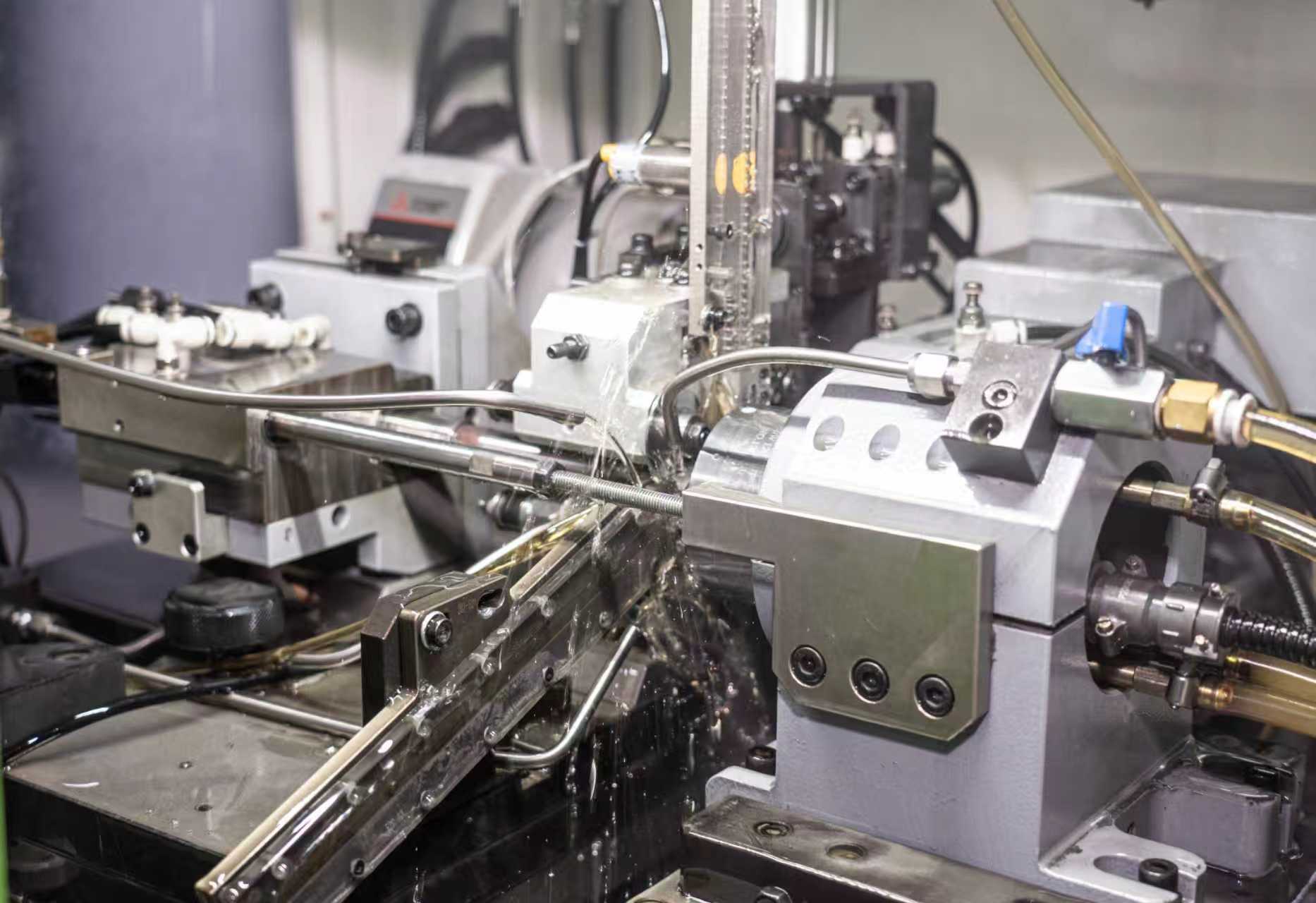
Precision bearing inspection workstation (Model VMS-2010F) in the LNB-BRG factory — dimensional and roundness verification sits behind any P4 claim.
Industry Background: Market, Standards and Material
Miniature bearings sit inside a market driven largely by two demand centres: medical devices and robotics. Estimates of the global miniature ball bearing market differ significantly between research firms — approximately USD 2.25 billion in 2025 according to Future Market Insights, USD 2.89 billion according to Precedence Research, and USD 2.0 billion according to IMARC Group. That divergence is itself a useful signal: any single market figure should be treated as a range estimate, not as a precise fact.
What the same sources broadly agree on is the regional and application picture. Asia Pacific held a revenue share of approximately 60% of the miniature ball bearing market in 2025, with China as the largest regional producer and consumer (Precedence Research). The automotive segment took the largest application share at approximately 39% in 2025, driven by EV motor and sensor applications (Precedence Research). On the supply side, China’s bearing exports grew 7.2% year on year in the first seven months of 2025 to nearly 497,852 tons, even while global unit pricing came under pressure (BearingNews / Huajing Research Institute).
Material choice is the other structural factor. Stainless steel 440C is the primary material for miniature bearings used in medical and food-processing applications because of its moisture and chemical resistance (SKDIN Engineering Guide). INB’s dental-handpiece models are produced in SUS440 stainless steel, and the company’s production range covers precision grades from P6 to P4 under an ISO 9001 quality management system.
What P4 Precision Actually Changes in Practice
P4 is a precision class, not a feature. It describes how tightly the manufactured dimensions of the inner ring, outer ring and rotating assembly are held to nominal. Tighter tolerances change four things that matter to a device designer:
- Runout at the shaft. A tighter bore and outer-diameter tolerance means the rotating assembly holds its position, which matters when the bearing also acts as a locating element in the assembly.
- Vibration and noise. Lower geometric variation produces lower vibration, which is the practical reason buyers ask for a low-noise miniature bearing. A recorded INB comparison against the SMR144Z reference lists noise performance below 20 dB, alongside high rotational speed and long service life.
- Consistency of preload and contact angle. At high speed and light load, small geometric differences translate into measurable differences in heat generation and running stability.
- Service life under the same duty. More even internal load distribution reduces the peak stress that drives fatigue in the raceways.
In the INB range, precision grades run from P6 to P4. The step between them is not a single measurement but the accumulation of tolerances across rings, balls and cage, and it is exactly that accumulation that separates a bearing which runs quietly for its rated life from one that begins generating heat early in a 300,000-plus rpm application.
What a Limiting Speed Rating Means — and Why 200,000 rpm Is Not 350,000 rpm
A limiting speed rating is the maximum rotational speed at which a bearing is rated to operate under defined lubricant, load and temperature conditions. It is a ceiling, not an operating target. Above it, the lubricant film degrades faster than it can be replenished, friction heat rises faster than the assembly can dissipate it, and the three failure modes described earlier move from possible to probable.
INB’s documented miniature bearing range is split across two speed bands, and the split shows what changes inside the bearing:
- 200,000 rpm band:SR133TL (2.38 × 4.762 × 2.38 mm) and SMR74TL (4 × 7 × 2 mm) — both P4, both SUS440 stainless steel, both rated for an operating temperature of -40 ℃ to 150 ℃.
- 350,000–400,000 rpm band:SMR144ZTLP4 W2.38 (3.175 × 6.35 × 2.38 mm) and SR144ZTLP4 W2.78 (3.175 × 6.35 × 2.78 mm) — both P4, both SUS440 stainless steel, both rated for an operating temperature of -50 ℃ to 160 ℃.
Two conclusions follow from this data. First, the higher speed band also carries the wider temperature range (-50 ℃ to 160 ℃ versus -40 ℃ to 150 ℃), which is consistent with a design that manages heat rather than merely tolerating it. Second, bore size alone does not determine the rating: the 3.175 mm bore models run faster than the 4 mm bore model, so the internal design — ball complement, cage, lubrication and seal configuration — is doing the work. That is why comparing two miniature bearings on bore size and “P4” alone is an incomplete comparison.
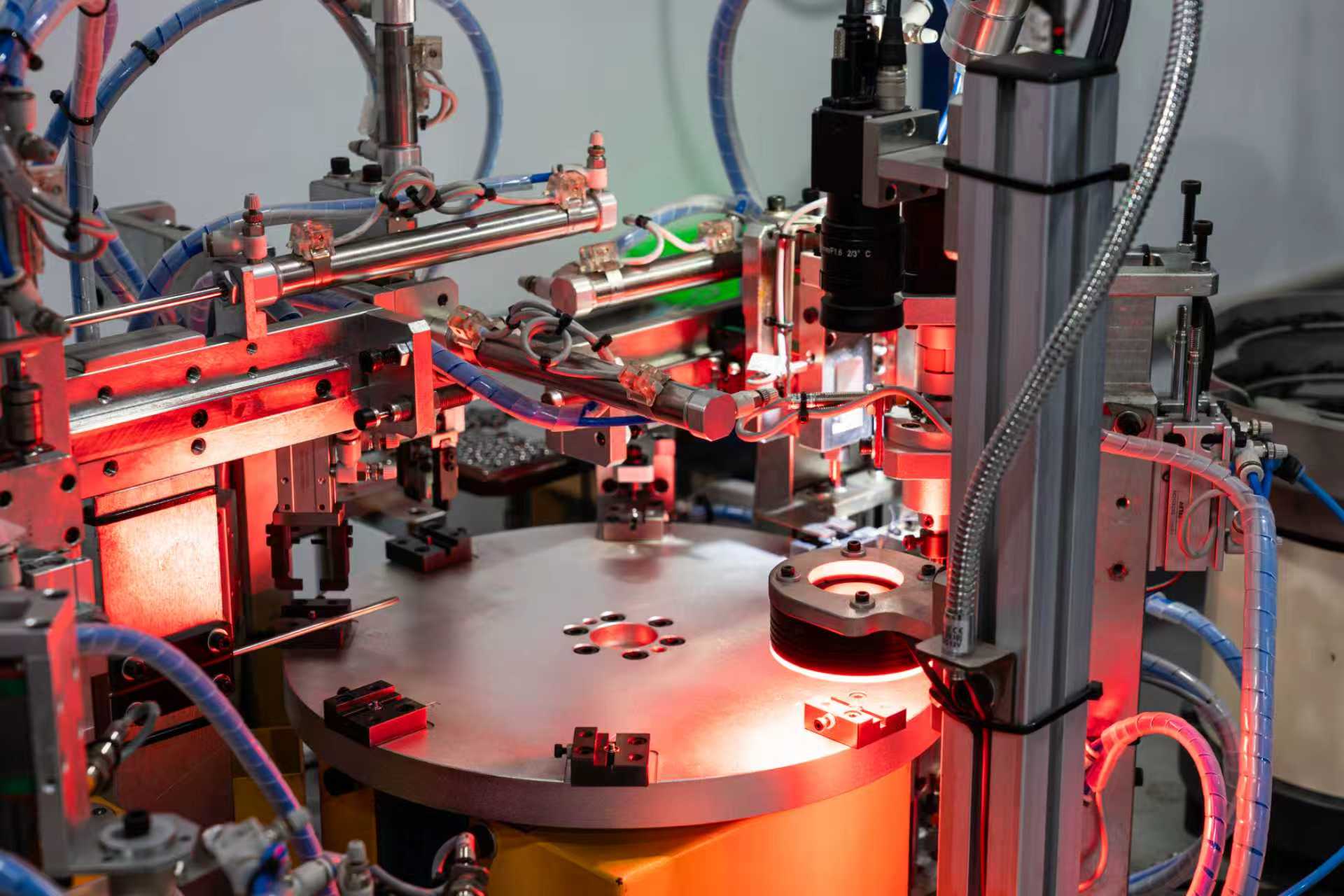
Worker debugging an intelligent CNC bearing processing center — the dimensional stability of the grinding process sets the ceiling on achievable precision class.
How INB Designs for P4 Precision and High-Speed Operation
The specification numbers on a datasheet are the visible output of four engineering decisions that INB documents across its miniature bearing range.
Material
The dental-handpiece models use SUS440 stainless steel, a 440-grade martensitic stainless that combines wear resistance with the moisture and chemical resistance that medical and food-processing environments demand. Material selection is also the first layer of thermal capability, because it determines how the raceway behaves when the contact zone heats up.
Lubrication and sealing
INB’s documented lubrication strategy is medical-grade permanent lubricant filling combined with a fully sealed labyrinth structure and wear-resistant alloy material, supported by periodic friction and wear performance testing. A fully sealed structure protects the lubricant charge from the environment, which is what allows a small bearing to hold its performance across a long service interval rather than degrading once the original lubricant film is disturbed.
Thermal management
Heat is the binding constraint in any high-speed miniature bearing. INB’s documented approach combines high-temperature resistant bearing material selection, an optimized heat conduction structure, and a real-time temperature monitoring module, validated through thermal cycle life testing across the -50 ℃ to 160 ℃ range.
Speed protection
A built-in mechanical speed limiter and a high-precision Hall effect speed sensor form the documented speed protection layer. In addition, 100% of units undergo speed performance validation before shipment, in line with medical device speed safety standards. This is the point at which “limiting speed” stops being a catalogue number and becomes a verified property of the shipped part.
Inspection and production capacity
Manufacturing is carried out under an ISO 9001 quality management system and supported by a full set of professional testing instruments, including hardness testers, roundness meters, profilometers, roughness measuring equipment and microscopes. Acceptance is based on 100% factory inspection. Monthly production capacity is 500,000 units, with annual output of 6,000,000 units — a capacity level relevant to buyers who need the same precision part supplied consistently over multiple production cycles rather than in a single one-off lot.
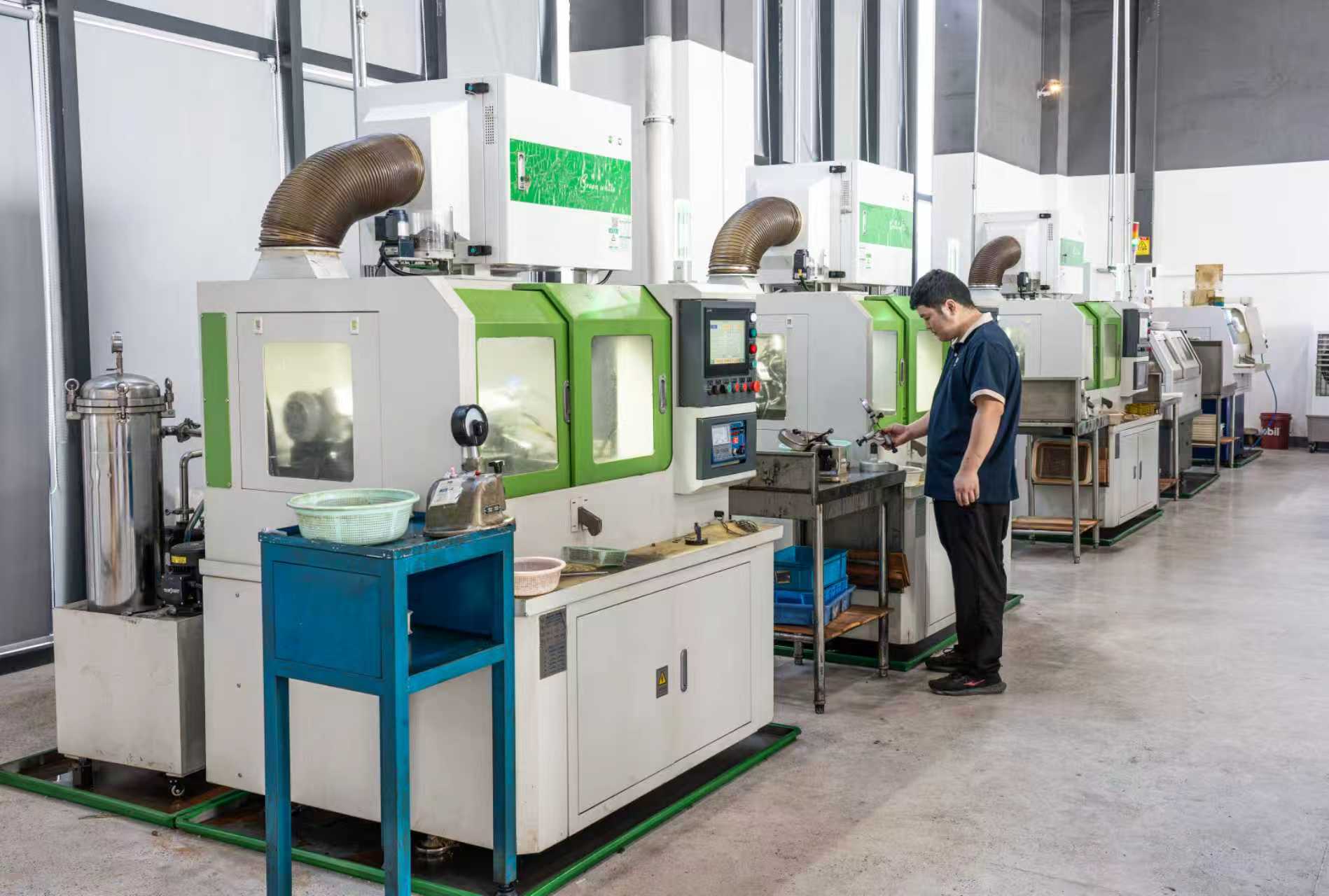
High-precision automated bearing assembly line with red light illumination.
Step-by-Step: Specifying a P4 Miniature Bearing for a High-Speed Design
The sequence below is the order in which the specification decisions interact. Changing a later step forces a review of the earlier ones.
Step 1 — Fix the bore and envelope first
Measure the shaft and the housing before opening any catalogue. Imperial-bore miniature bearings remain common in older instrument and handpiece designs, so a nominal imperial bore should be converted to metric before it is compared with a metric quotation — the 3.175 mm bore is the metric expression of a 1/8 in bore, and the 4.762 mm bore corresponds to the 3/16 in bore convention. INB’s documented bores in this family include 2.38 mm (SR133TL), 3.175 mm (SMR144ZTLP4 W2.38 and SR144ZTLP4 W2.78) and 4 mm (SMR74TL).
Step 2 — Match material and temperature to the operating environment
If the assembly is exposed to moisture, cleaning agents or sterilisation cycles, stainless steel is the starting point. Then check the temperature rating against the actual duty: the 3.175 mm bore models are rated -50 ℃ to 160 ℃, while the 2.38 mm and 4 mm bore models are rated -40 ℃ to 150 ℃. A margin between the rated range and the real operating range is what keeps lubricant life predictable.
Step 3 — Set the precision class from the motion requirement
Choose P4 when runout, noise or running stability directly affects device performance; choose P6 where the bearing is carrying load rather than defining position. Do not choose a class by habit — an unnecessary precision step raises cost without changing field performance.
Step 4 — Test the speed requirement against the limiting speed with margin
Compare the design working speed, not the peak no-load speed, against the limiting speed rating. A handpiece that occasionally touches its top speed and one that runs continuously near the ceiling place very different demands on lubricant and heat path.
Step 5 — Validate before committing to volume
Use the supplier’s pre-shipment validation as the acceptance basis. INB’s documented terms are 100% factory inspection, 100% speed performance validation before shipment, a minimum order quantity of 50 units, FOB delivery and payment before shipment.
Scope note: this article covers radial miniature bearings in the bore range discussed above. A flanged stainless steel miniature bearing answers a different design problem — axial retention built into the outer ring — and should be specified as a separate configuration rather than substituted into the step sequence above.
Use Cases: Where P4 Miniature Bearings Actually Run
Dental handpieces. This is the primary documented application for all four models in the INB range. The 3.175 mm bore models (SMR144ZTLP4 W2.38 and SR144ZTLP4 W2.78) sit in the 350,000–400,000 rpm band with a -50 ℃ to 160 ℃ operating range, matching a turbine-driven handpiece’s combination of high rotational speed and heat generation in a sealed, sterilisable body.
Micro-motors. INB’s products mainly serve the domestic medical device industry and micro-motors. In motor applications the bearing defines both the position of the rotor and the acoustic signature of the drive, which is where the low-noise and low-friction characteristics of a P4 part become visible to the end user.
Medical and laboratory instruments. Instruments that are cleaned, sterilised or used in humid environments benefit from the 440-grade stainless construction, and instruments with a rotating probe or spindle depend on the runout control that the higher precision class provides.
Adjacent demand centres. Beyond medical devices, the largest application share in the wider miniature bearing market is automotive, at approximately 39% in 2025, driven by EV motor and sensor applications (Precedence Research). Robotics, instrumentation and food-processing equipment follow similar logic: compact envelopes, high rotational speed, and a requirement that the part keep its geometry across a long service interval.
Comparison Table: INB P4 Miniature Bearing Models and Ratings
| Model | Size (bore × OD × width) | Precision | Limiting speed | Operating temperature | Material | Documented application |
|---|---|---|---|---|---|---|
| SMR144ZTLP4 W2.38 | 3.175 × 6.35 × 2.38 mm | P4 | 350,000–400,000 rpm | -50 ℃ ~ 160 ℃ | SUS440 | Dental handpiece |
| SR144ZTLP4 W2.78 | 3.175 × 6.35 × 2.78 mm | P4 | 350,000–400,000 rpm | -50 ℃ ~ 160 ℃ | SUS440 | Dental handpiece |
| SR133TL | 2.38 × 4.762 × 2.38 mm | P4 | 200,000 rpm | -40 ℃ ~ 150 ℃ | SUS440 | Dental handpiece |
| SMR74TL | 4 × 7 × 2 mm | P4 | 200,000 rpm | -40 ℃ ~ 150 ℃ | SUS440 | Dental handpiece |
One further data point is useful when the comparison goes beyond dimensional fit. A recorded INB comparison against the SMR144Z reference lists high rotational speed, low noise (below 20 dB), long service life and a cost position approximately 10% lower, with maintenance characteristics described as high speed, low noise, low heat generation and long lifespan, and an efficiency profile of low friction coefficient, low heat generation and high transmission efficiency. Those are comparative observations recorded against a specific reference part, not universal claims — which is exactly how supplier comparison data should be read.
Risk Points and Documented Control Measures
Three risks dominate high-speed miniature bearing applications, and each has a documented control path rather than a general recommendation.
| Risk type | Control method | Documented measure |
|---|---|---|
| Premature wear & lubrication failure | Sealed lubrication control & wear rate monitoring | Medical-grade permanent lubricant filling, fully sealed labyrinth structure, wear-resistant alloy material, periodic friction and wear performance testing |
| Thermal fatigue & overheating | Thermal management & active temperature protection | High-temperature resistant bearing material selection, optimized heat conduction structure, real-time temperature monitoring module, thermal cycle life testing under -50 ℃ ~ 160 ℃ range |
| Over-speeding | Speed limitation & real-time rotational speed monitoring | Built-in mechanical speed limiter, high-precision Hall effect speed sensor, 100% speed performance validation before shipment, compliance with medical device speed safety standards |
FAQ
Which standard defines P4 precision, and can two P4 quotations be compared directly?
Miniature bearing precision is governed by several international systems, including ABMA ABEC (1–9), ISO 492 and DIN 620, and within the ABEC system higher numbers correlate to tighter tolerances (AST Bearings). Because the systems use different labels, two quotations both marked P4 should be compared on the underlying bore, outer-diameter and runout values stated against a named standard, not on the label alone. INB produces high-precision standard bearings in precision grades from P6 to P4 under an ISO 9001 quality management system.
Can one supplier cover the full small-bore range a high-speed device needs?
INB produces high-precision standard bearings with inner bore diameters from 2 mm to 8 mm. Within that range, the documented dental-handpiece models span 2.38 mm, 3.175 mm and 4 mm bores, all in P4. Two of them carry a 350,000–400,000 rpm limiting speed and the other two are rated at 200,000 rpm, so a single supplier range can cover both the extra miniature end of the scale and slightly larger bores used elsewhere in the same device.
What are the minimum order quantity and commercial terms?
The documented terms for INB miniature bearings are a minimum order quantity of 50 units, FOB delivery, payment before shipment, and acceptance based on 100% factory inspection. Because precision class, material and lubrication configuration all affect the manufactured part, these terms apply to the specific model and specification agreed at quotation stage rather than to the category as a whole.
How can a buyer validate P4 precision and the speed rating before ordering volume?
Validation is built into the documented production and acceptance process: dimensional and surface inspection with hardness testers, roundness meters, profilometers, roughness measuring equipment and microscopes; 100% factory inspection; 100% speed performance validation before shipment; and thermal cycle life testing across the -50 ℃ to 160 ℃ range. A buyer can therefore assess a candidate part against the same measurements the supplier uses, and can request a sample or quotation for the specific model under evaluation before committing to a production schedule.
What supports long-term, repeat supply of the same precision part?
Continuity depends on production capacity and process control rather than on a single delivered lot. INB’s documented capacity is 500,000 units per month and 6,000,000 units per year, produced in a 2,000 m² facility by a team of 30, including an R&D team of ten with three senior bearing engineers. Distributors and OEM buyers planning repeat programmes can confirm model availability and scheduling directly with the sales team.
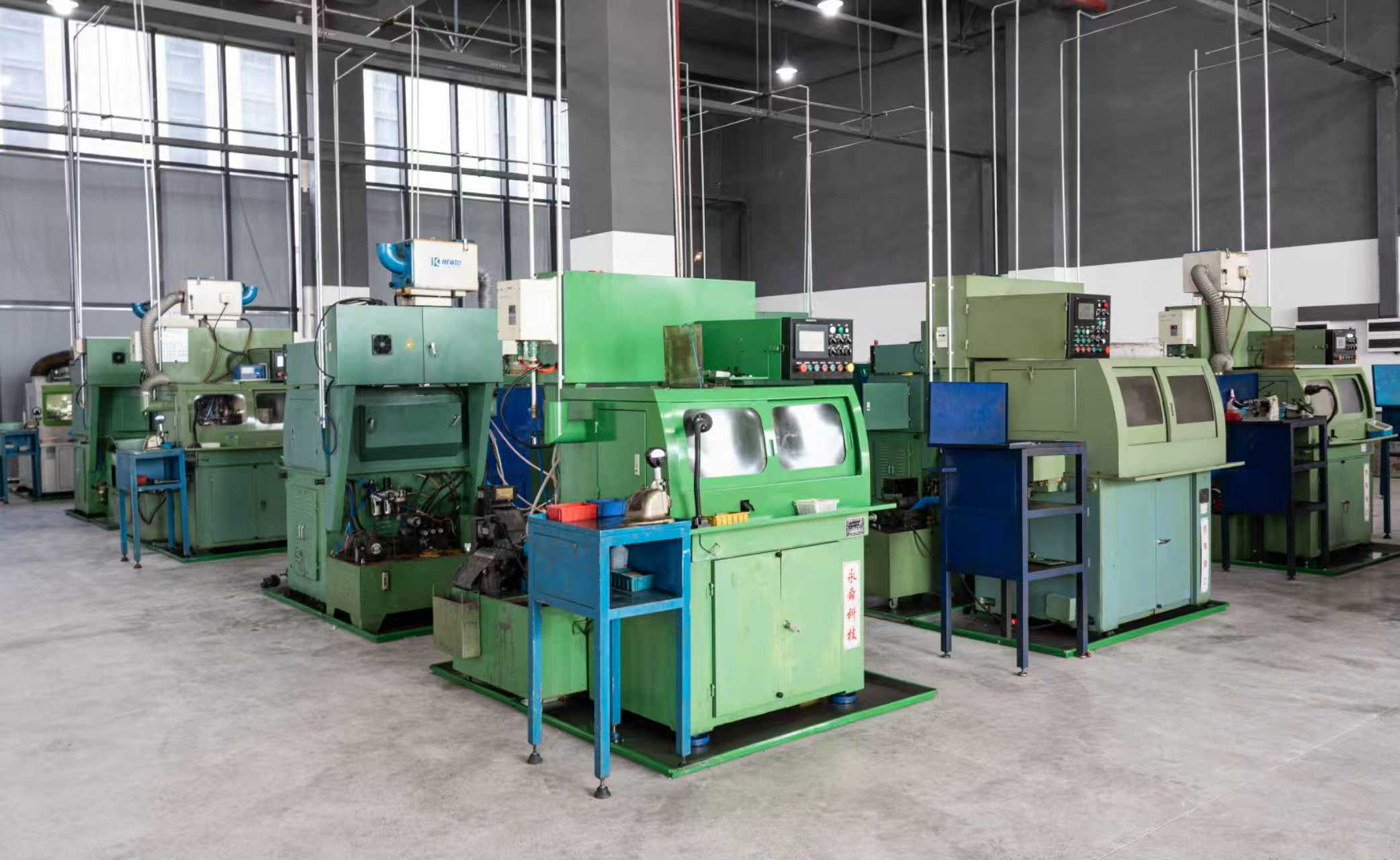
Bearing processing machine with cooling liquid in the LNB-BRG production line.
Conclusion: Three Rules That Prevent Most Miniature Bearing Specification Errors
First, treat precision as a tolerance table, not a label: P4, ABEC and DIN classes only become comparable once the bore, outer-diameter and runout values are stated against a named standard. Second, treat limiting speed as a ceiling tied to lubrication, load and temperature, not as a feature — which is why the 200,000 rpm and 350,000–400,000 rpm bands in the INB range sit alongside different temperature ratings rather than being interchangeable. Third, verify before volume: 100% factory inspection and 100% pre-shipment speed validation turn a datasheet claim into an inspected property of the shipped part.
Next Step: Sample, Quotation or Specification Review
If you are specifying a P4 miniature bearing for a high-speed application, the fastest way to close the gap between a datasheet and a working design is to test the actual part. INB — the miniature bearing brand of Ningbo City Jingyin Electromechanical Technology Co., Ltd., based in Ningbo, Zhejiang Province, China — supplies P4 stainless steel miniature bearings for dental handpieces, micro-motors and medical devices, with model-specific samples, quotations and specification review available on request.
Contact: Wang Chaojiang · Email: yuhang001@126.com · Tel / WhatsApp: +86 18957446001 · Address: Building 9, Beikun Industrial Area, No. 2288 Yongmao West Road, Zhuangqiao Street, Jiangbei District, Ningbo City · Website: www.lnb-brg.com
Have Questions or Need More Details?
Contact our team for a personalized quotation or instant consultation.
Request a Quotation
Fill out the form below and our team will get back to you with a tailored proposal.
WhatsApp Direct Chat
Prefer to chat in real-time? Message us on WhatsApp for instant assistance & quick answers.
- Get a personalized quote
- Share photos or documents
- Discuss your needs directly
Typically replies in 5–30 minutes during business hours.