
Understanding P4 Precision in Miniature Bearings: What It Means and When You Need It
P4 is a precision, or tolerance, class for rolling bearings. It defines how tightly a manufacturer must hold the specified dimensional and running-accuracy tolerances of the finished bearing: the bore, the outside diameter, the width, and how far the rotating ring deviates from a true axis as it turns.
The class says nothing about the material, the lubricant, the cage, the load rating or the limiting speed of the bearing. Those are separate specifications. A datasheet can carry a P4 class alongside a wide or narrow temperature range, a hard or corrosion-resistant steel, and a low or very high speed rating, and it usually does.
Two very different buying situations sit behind that one abbreviation. In the first, an engineer selects P4 deliberately, because a bearing with a 3.175 mm bore turning at hundreds of thousands of revolutions per minute will otherwise convert geometric error into vibration, noise and heat. In the second, P4 is read as a general quality label, and the buyer pays for tolerance control the mechanism never uses.
This article separates the two: what the P4 class actually specifies, how it is measured and verified in production, and the questions that decide whether a given assembly needs it. INB, the miniature bearing brand of Ningbo City Jingyin Electromechanical Technology Co., Ltd. (Ningbo, China, established 2014), produces miniature bearings in precision grades from P6 to P4. Two of its P4-rated models, SMR144ZTLP4 W2.38 and SR144ZTLP4 W2.78, are used as worked examples throughout.
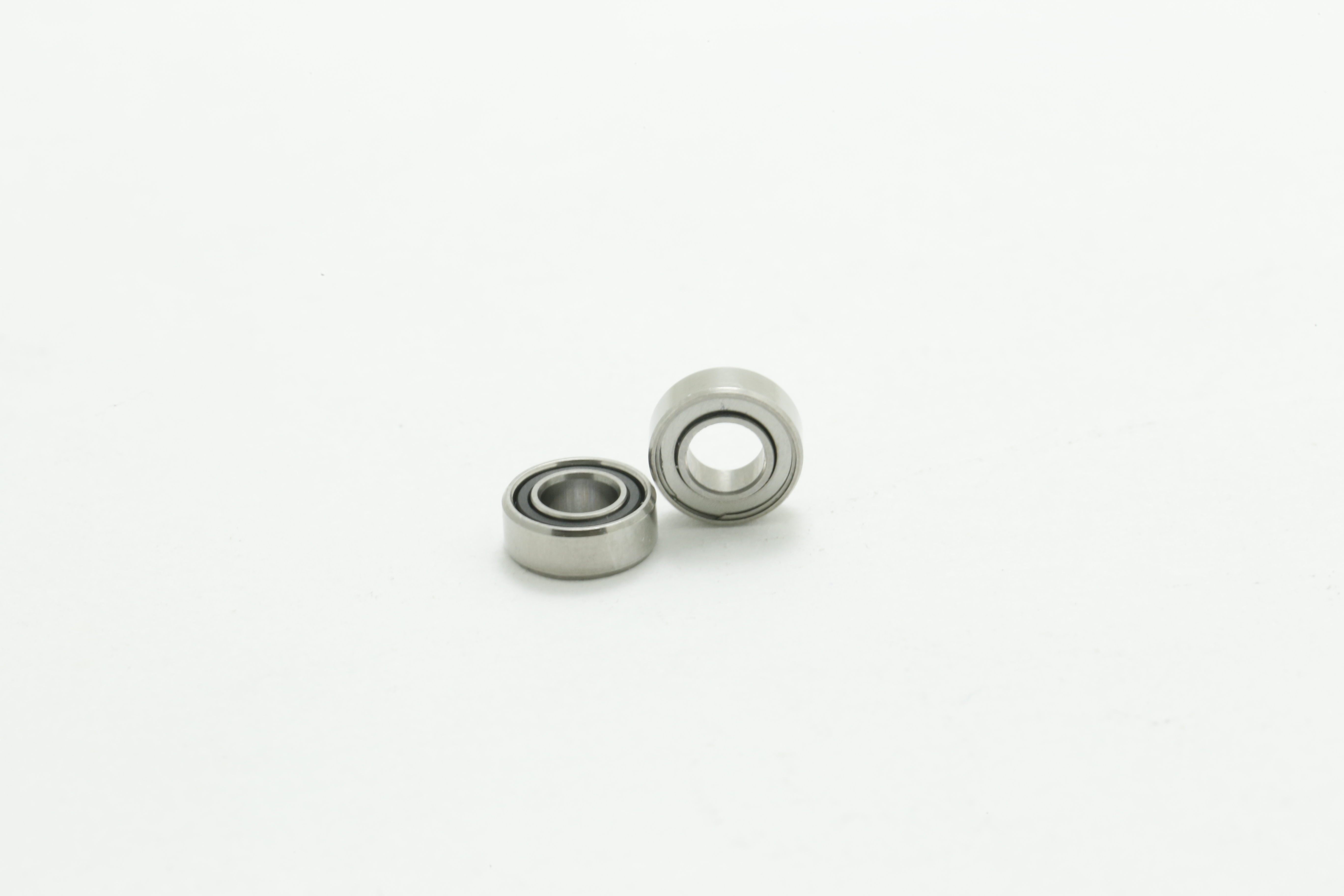
Problem Definition: Three Ways P4 Gets Misread
The rating is frequently read as a material grade, as a speed class, or as a general quality badge. Each reading produces a different purchasing error, and each one is corrected by a single distinction.
1. Treating P4 as a material or quality grade
Precision class and material are separate decisions. In medical and food-processing equipment, 440C stainless steel is the primary material choice for miniature bearings because of its resistance to moisture and chemicals, and that is a material decision made independently of how tight the tolerance class needs to be. INB's P4-rated miniature bearings are made of SUS440 stainless steel, yet the steel and the class are quoted as two different specifications.
2. Treating P4 as a speed rating
Running speed and tolerance class are also independent. INB's SR133TL and SMR74TL are P4-rated with a limiting speed of 200,000 rpm. SMR144ZTLP4 W2.38 and SR144ZTLP4 W2.78 are P4-rated as well, but specified at 350,000 to 400,000 rpm. Same class, two different speed bands. Speed alone therefore does not tell a designer which class to order, and class alone does not tell a designer what speed a layout can reach.
3. Mixing class notations
Miniature bearing precision is governed by global standards including ABMA ABEC (classes 1 to 9), ISO 492 (P0 to P2) and DIN 620, and in the ABEC system a higher number corresponds to tighter tolerances. Because the notations are not identical, a quotation that says P4 without naming the standard behind it, or that mixes an ABEC number with a P-class, cannot be compared reliably against another supplier's offer.
Industry Background: Why Precision Is Now a Purchasing Question
The global miniature ball bearings market was estimated at approximately USD 2.25 billion in 2025 by Future Market Insights, which cites demand in medical devices and robotics as a driver. Third-party estimates for the same year differ: Precedence Research reports a figure of about USD 2.89 billion and IMARC about USD 2.0 billion, so market size is best read as an order of magnitude rather than a precise number. The regional picture is more consistent. Asia Pacific accounted for approximately 60% of miniature ball bearing revenue in 2025, with China the largest regional producer and consumer.
Volume is moving. China's bearing exports grew 7.2% year on year in the first seven months of 2025, reaching nearly 497,852 tons, even while global unit pricing faced pressure. The largest single application segment in 2025 was automotive, at approximately 39% of the market, driven by electric-vehicle motor and sensor applications. Miniature bearings are no longer a niche medical component; they are a volume industrial part.
That volume is what turns precision classes into a purchasing question rather than a technical footnote. The sector includes large global manufacturers such as MinebeaMitsumi, NSK, SKF and Schaeffler (Barden), alongside specialist producers. On paper, the way a buyer separates them is by comparing tolerances, materials and ratings that follow the same written standards.
Inside a dental handpiece or a small precision drive, three properties interact: precision, meaning how far the rotating ring deviates from true rotation; speed, meaning how fast the assembly turns; and vibration, meaning how much of that deviation becomes noise and heat. The higher the speed, the more expensive any residual geometric error becomes.
What the P4 Rating Actually Specifies
A precision class governs geometry, not materials and not performance ratings. The class sets the permitted deviation on the bearing's principal dimensions, which are bore diameter, outside diameter and width, and on running accuracy, which is the deviation of the rotating ring from a true axis of rotation while the bearing turns.
Those two groups map onto two different failure modes. Dimensional tolerance controls fit: how the bearing seats on a shaft and inside a housing, and therefore how much preload or clearance the assembly actually has. Running accuracy controls motion: the runout and roundness deviation that, at high speed, is converted into vibration, audible noise and heat generation.
The numeric tolerance values for each class live in the standards tables (ISO 492, DIN 620, ABMA). A buyer who needs specific limits should ask for the standard name and the class in writing rather than relying on the shorthand P4 on its own.
INB's P4-rated range shows that separation in practice. The class is constant across the models compared later in this article, while the bore sizes, widths, speed ratings and temperature envelopes differ from model to model. INB produces high-precision standard miniature bearings with bore diameters from 2 mm to 8 mm, in precision grades from P6 to P4, and its P4 miniature bearings are supplied with fully stated speed, temperature and material specifications.
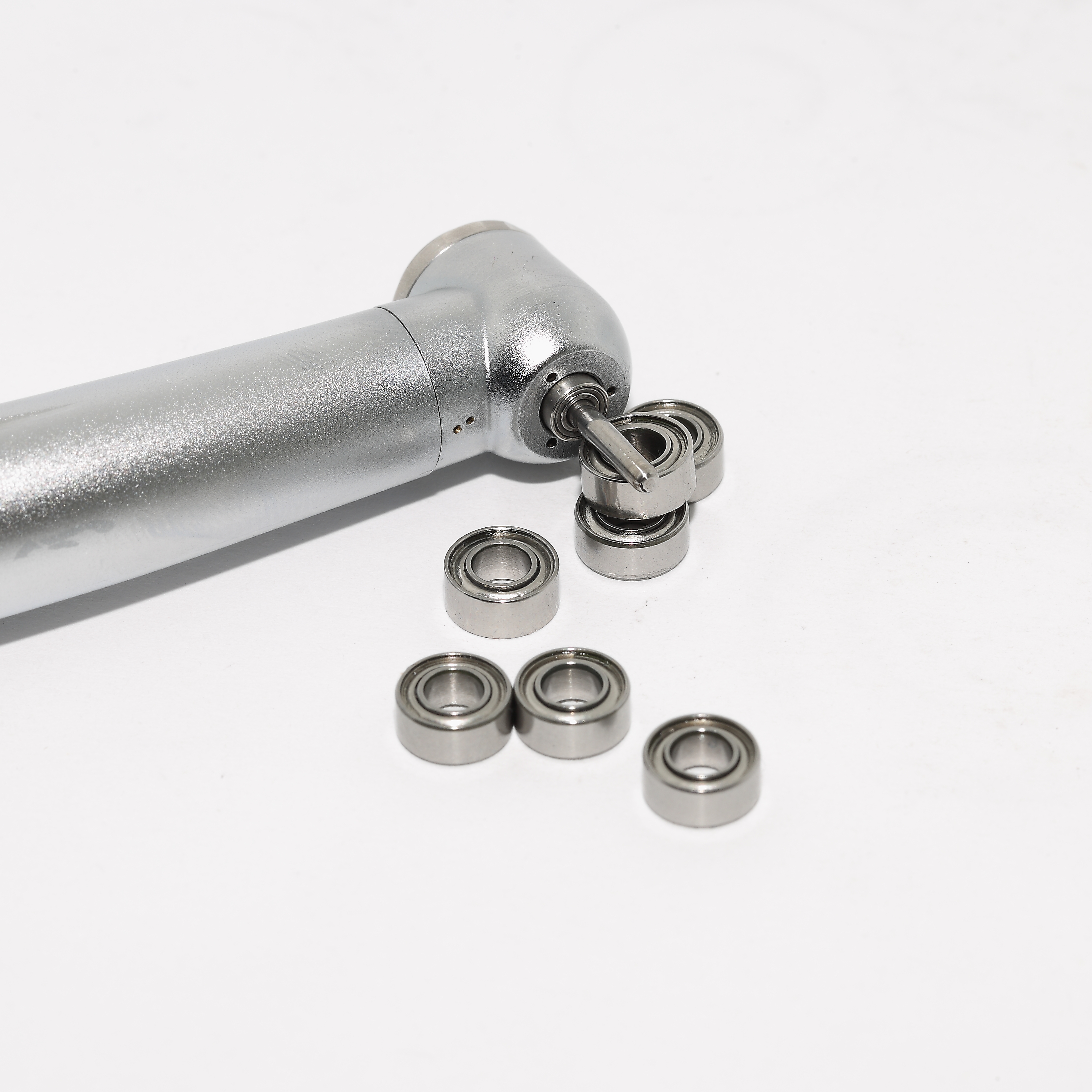
How P4 Precision Is Measured and Verified
A precision class is a metrology claim before it is anything else. The parameters that define running accuracy, such as the roundness and surface roughness of the rings and raceways, are measured on instruments rather than judged by eye, and the ability to claim P4 depends on owning those instruments.
INB's inspection equipment includes hardness testers, roundness meters, profilometers, roughness measuring equipment and microscopes, and the company's operation is carried out in accordance with the ISO 9001 quality management system. The bearing operation employs approximately 30 staff, including a 10-engineer research and development team and three senior engineers with experience in the bearing industry.

For a buyer, the useful part of that equipment list is the mapping between parameter and instrument. Roundness meters and profilometers address the geometric properties that a precision class governs. Roughness measurement addresses surface finish, which affects friction, lubricant film behaviour and noise. Hardness testers address material condition, which is a separate specification from the class and should be quoted separately.
Three questions belong in a supplier audit whenever a P4 claim is being evaluated:
- Which standard and which class does the quotation follow, and are both written on the drawing?
- Which instrument is used to measure roundness and roughness on the finished bearing, and are records available per batch?
- Is inspection performed on finished bearings, or on components before assembly?
One limitation belongs alongside those questions: a class statement plus an inspection record describes geometry and material condition. It does not predict service life in a specific assembly. Life in a dental handpiece turbine depends on lubrication, fit, load history and installation practice as much as on the tolerance class, which is why the assessment below keeps the class decision and the application decision separate.
Step-by-Step Breakdown: Deciding Whether Your Assembly Needs P4
Work through the seven points below in order. Each one produces a specification that can be written into a drawing or an RFQ, and each one can be answered without quoting a price.
- Name the performance driver. Start with what the assembly must do better: accept speed, reduce noise and vibration, survive sterilisation and moisture, or reduce unit cost. P4 is justified when runout-driven vibration, noise or heat is the limiting factor. If the limiting factor is corrosion resistance, the decision concerns stainless steel such as SUS440 rather than the tolerance class.
- Fix the material separately from the class. Medical and food-processing environments typically call for 440C stainless steel because of its resistance to moisture and chemicals. All four P4 models compared below use SUS440. Material is quoted as its own line item; the precision class does not change it.
- Set the speed band from the mechanism, not from a catalogue maximum. The dental handpiece application served by INB's SMR144ZTLP4 W2.38 is specified for high-speed precision grinding with intermittent high-speed operation and intermittent high-load operation, in a 350,000 to 400,000 rpm band. The SR133TL and SMR74TL models are specified at 200,000 rpm for lower-speed miniature bearing duties. Both bands are available at P4 grade.
- Check the thermal envelope. Operating temperature is specified per model: minus 50 degrees Celsius to 160 degrees Celsius for SMR144ZTLP4 W2.38 and SR144ZTLP4 W2.78, and minus 40 degrees Celsius to 150 degrees Celsius for SR133TL and SMR74TL. Sterilisation cycles and continuous running both push a bearing toward the upper end of that envelope, so the temperature rating should be matched before the class is locked.
- Decide which positions in the assembly need P4. Precision requirements are positional. A handpiece may need P4 at the turbine position, where runout becomes palpable vibration in the operator's hand, while a less exposed position in the same device can accept a lower grade. Because INB produces miniature bearings from P6 to P4, a mixed specification inside one assembly is a normal request rather than an exception.
- Validate with samples before freezing the bill of materials. Drawings and datasheets transfer dimensions, speed ratings and temperature limits. They do not transfer how a bearing behaves in a handpiece after a sterilisation cycle, which is why sample validation is the step where the class decision is confirmed against the real assembly.
- Document the specification. Close the loop by recording the model, precision class, the standard it follows, material, limiting speed, operating temperature and the inspection evidence for the batch. That record is what makes a repeat order repeatable and an incoming inspection meaningful.

Use Cases: Where P4 Is Justified, and Where It Is Not
Dental handpieces
A dental handpiece turbine is a compact, high-speed, hand-held mechanism, and the application INB supplies for is specified as high-speed precision grinding in a clean medical environment with intermittent high-load operation. That specification calls for P4 precision, a 350,000 to 400,000 rpm speed band, a minus 50 degrees Celsius to 160 degrees Celsius temperature range, medical-grade hygiene and low noise. The requirements are joined because they reinforce each other: a bearing held in the operator's hand transmits runout directly to the user, and the air turbine that drives it reaches those speeds only if the rotating geometry stays tight. This is also the application where volume matters, since one production project supplied 80,000 miniature bearings for dental handpieces in China.
Micro-motors and small precision drives
The same logic applies wherever a small rotor turns fast inside a device a person holds or listens to. INB's stated product focus is the medical device industry and micro-motors, with the Chinese market as its main market. Both segments are cases where vibration and noise specifications, rather than load capacity, usually decide the precision class.
Industrial equipment
In industrial equipment, precision classes rise for the same underlying reason: as spindle and motor speeds increase, geometric error is converted into vibration and heat. The evaluation method does not change. Identify the speed band, the thermal envelope and the vibration limit, then select the class that satisfies them. The difference in industrial settings is that service life and downtime cost are usually quantified, which makes over-specifying easier to justify than it is in a consumable device.
Where P4 is not needed
P4 is not the required answer for a slow-turning or hand-driven assembly, or for a cost-driven mechanism in which vibration is not perceptible. In those cases a standard high-precision grade such as P6 delivers the fit and function without paying for tolerance control the mechanism cannot use.

Comparison Table: P4 Models and the Standards Behind the Rating
The table below lists INB's P4-rated miniature bearing models with the specifications published for each. Every row carries the same precision class. What differs is the size envelope, the speed rating and the temperature range, which is the practical proof that a precision class is one variable among several rather than a summary of the whole bearing.
| Model | Bore x OD x Width (mm) | Precision | Limiting speed | Operating temperature | Material | Typical application |
|---|---|---|---|---|---|---|
| SMR144ZTLP4 W2.38 | 3.175 x 6.35 x 2.38 | P4 | 350,000 to 400,000 rpm | minus 50 to 160 degrees C | SUS440 | Dental handpiece |
| SR144ZTLP4 W2.78 | 3.175 x 6.35 x 2.78 | P4 | 350,000 to 400,000 rpm | minus 50 to 160 degrees C | SUS440 | Dental handpiece |
| SR133TL | 2.38 x 4.762 x 2.38 | P4 | 200,000 rpm | minus 40 to 150 degrees C | SUS440 | Dental handpiece |
| SMR74TL | 4 x 7 x 2 | P4 | 200,000 rpm | minus 40 to 150 degrees C | SUS440 | Dental handpiece |
SMR144ZTLP4 W2.38 and SR144ZTLP4 W2.78 share a 3.175 mm bore and a 6.35 mm outside diameter and differ in width, at 2.38 mm and 2.78 mm respectively. Selecting between them is a width and envelope decision; both remain P4 precision and both are rated for the same speed band and temperature range.
The second table lists the standard systems that govern miniature bearing precision, because a quotation is only comparable when the system behind the class is named.
| Standard body | Class designations | What it means in a quotation |
|---|---|---|
| ABMA (ABEC) | Classes 1 to 9 | Higher numbers correspond to tighter tolerances |
| ISO 492 | P0 to P2 | International class series referenced in miniature bearing specifications |
| DIN 620 | Referenced alongside ISO 492 | European standard used when precision classes are written into procurement documents |
Where one supplier quotes an ABEC class and another quotes a P-class, the two numbers cannot be compared until both are stated against the same standard. That is a documentation gap rather than a quality gap, and it is closed with one question in the RFQ.
Frequently Asked Questions
Which standards define a P4 bearing, and how do ABEC, ISO and DIN classes relate?
Miniature bearing precision is governed by global standards including ABMA ABEC (classes 1 to 9), ISO 492 (P0 to P2) and DIN 620, and in the ABEC system a higher number corresponds to tighter tolerances. The P-prefix notation belongs to the ISO and DIN class system, so the practical rule is to state the standard and the class together on drawings and quotations. INB manufactures miniature bearings in precision grades from P6 to P4 and operates in accordance with the ISO 9001 quality management system.
Can a P4 miniature bearing really run at 350,000 to 400,000 rpm?
Speed capability is specified separately from the precision class. INB's SMR144ZTLP4 W2.38 (3.175 x 6.35 x 2.38 mm) and SR144ZTLP4 W2.78 (3.175 x 6.35 x 2.78 mm) are P4-rated with a limiting speed of 350,000 to 400,000 rpm and an operating temperature of minus 50 to 160 degrees Celsius. INB's SR133TL (2.38 x 4.762 x 2.38 mm) and SMR74TL (4 x 7 x 2 mm) are also P4-rated, but specified at 200,000 rpm and minus 40 to 150 degrees Celsius. The limiting speed in a specification is a rating; the speed a specific assembly can sustain also depends on load, lubrication and fit.
Does specifying P4 change the cost of the bearing?
Cost follows the tolerance work involved. A tighter class requires tighter process control and more measurement per batch, including roundness and roughness checks, and that effort, together with model, material and quantity, is what drives quotation levels; there is no single price difference that applies to every P4 bearing. The budget lever available to a designer is scope: apply P4 only to the positions where runout-driven vibration or heat is the limiting factor, and specify a lower grade such as P6 where it is not. Because INB produces both grades, a mixed specification can stay with one supplier.
Can we test a P4 miniature bearing before committing to a full order?
Sample and quotation requests are handled through INB's contact channels: email yuhang001@126.com, or phone and WhatsApp on +86 18957446001. Send the model, for example SMR144ZTLP4 W2.38, together with the quantity, the application, and the speed and temperature envelope the bearing must operate in, so that the sample supplied matches the intended duty rather than the nearest catalogue item.
How is lead time determined for a P4 miniature bearing order?
Delivery schedules are confirmed per order rather than fixed in advance, because the schedule depends on the model, the quantity and the material batch required. The reliable approach is to state the required date at the inquiry stage together with the model list and the volume, and to confirm the schedule in writing before the order is placed. For a schedule confirmation, write to yuhang001@126.com, call or message +86 18957446001, or review the miniature bearing range at www.lnb-brg.com.
Conclusion: Treat P4 as One Specification Among Several
P4 is a tolerance class. It fixes how tightly bore, outside diameter, width and running accuracy must be held, and it leaves material, lubrication, load rating, limiting speed and operating temperature to be specified separately. INB's own range demonstrates the separation in practice: four P4-rated miniature bearing models spanning different bore sizes, widths, speed bands and temperature envelopes, all produced in SUS440 stainless steel.
The decision rule that follows is short. First identify whether runout-driven vibration, noise or heat limits the mechanism. If it does, P4 is justified at that position, and the model, material and thermal envelope are selected to match the duty. If it does not, a lower grade such as P6 performs the same function without the tolerance cost.
Then verify rather than assume. Ask which standard and class the quotation follows, which instruments measure roundness and roughness, and whether batch inspection records exist. Those three questions turn a precision claim into a specification a purchasing team can audit.
Next step: sample, catalogue or quotation
INB miniature bearings are produced by Ningbo City Jingyin Electromechanical Technology Co., Ltd. in Ningbo, China, in precision grades from P6 to P4, with bore diameters from 2 mm to 8 mm and an annual output of 6,000,000 units.
Email: yuhang001@126.com | Phone / WhatsApp: +86 18957446001 | Website: www.lnb-brg.com
Address: Building 9, Beikun Industrial Area, No. 2288 Yongmao West Road, Zhuangqiao Street, Jiangbei District, Ningbo City, China.

Have Questions or Need More Details?
Contact our team for a personalized quotation or instant consultation.
Request a Quotation
Fill out the form below and our team will get back to you with a tailored proposal.
WhatsApp Direct Chat
Prefer to chat in real-time? Message us on WhatsApp for instant assistance & quick answers.
- Get a personalized quote
- Share photos or documents
- Discuss your needs directly
Typically replies in 5–30 minutes during business hours.