
Selecting Miniature Bearings for 400,000 RPM Dental Handpieces
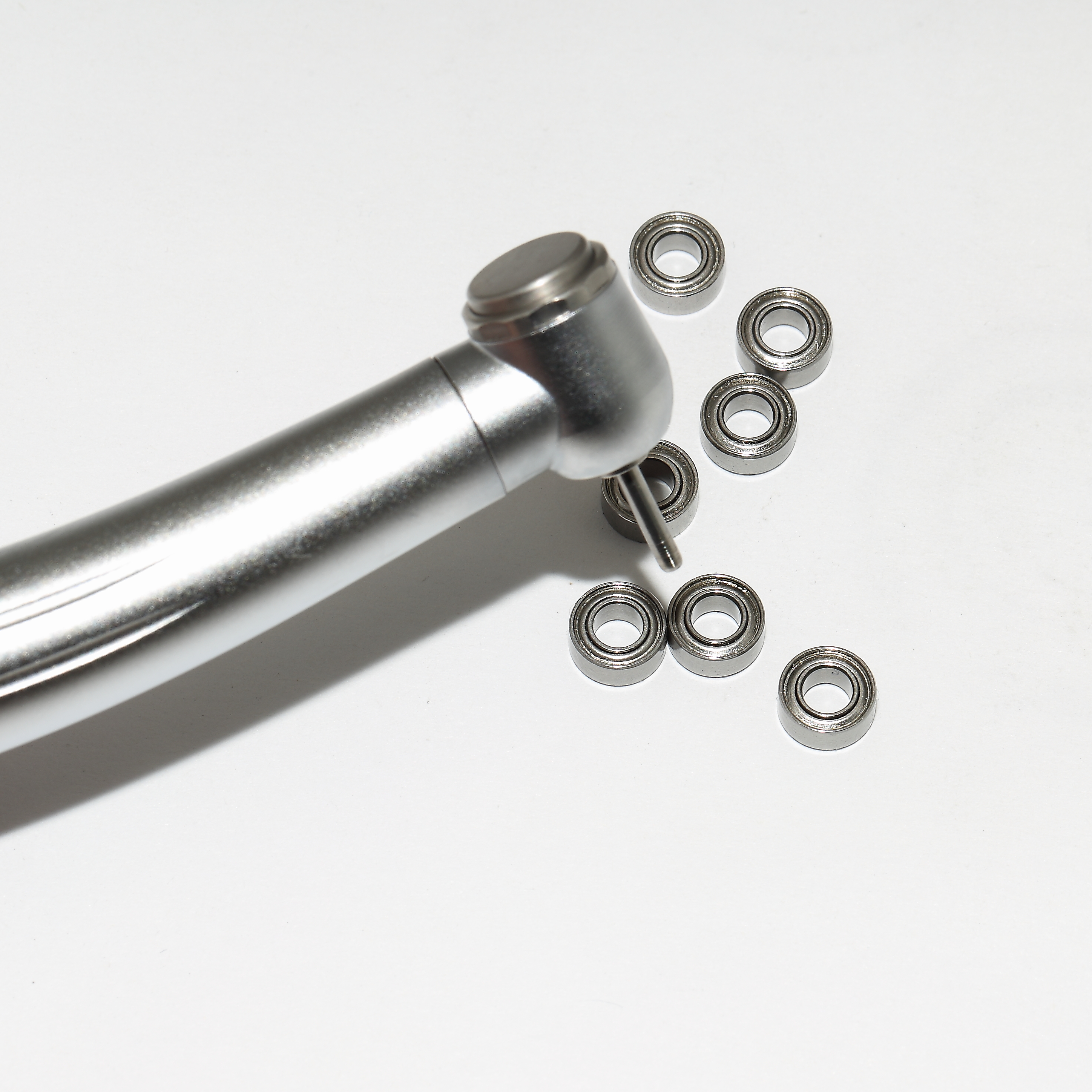
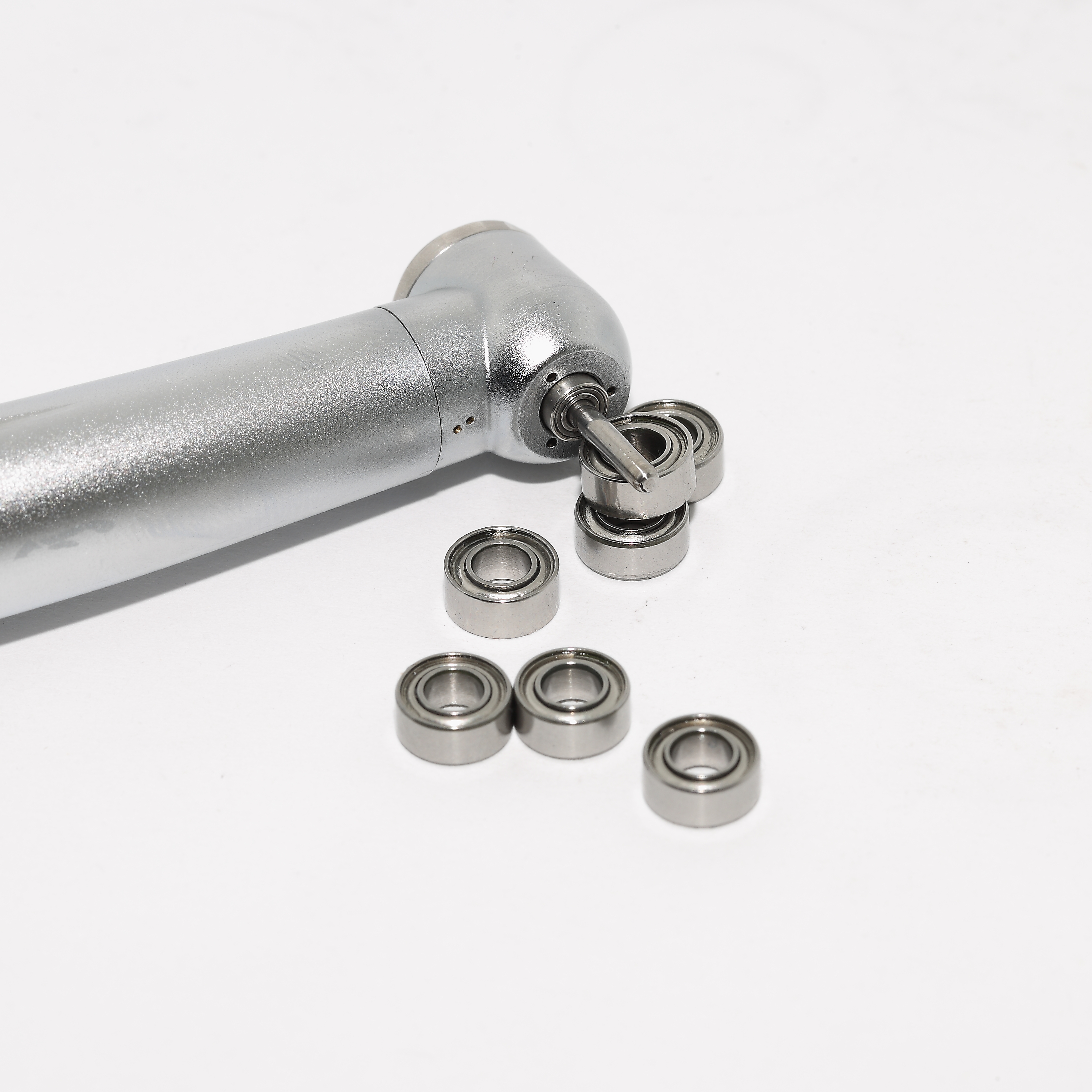
Answer first: A dental handpiece turbine running at up to 400,000 rpm requires a miniature bearing that satisfies four constraints at the same time — limiting speed, precision class, material and operating temperature. INB specifies the SMR144ZTLP4 W2.38 as a 3.175 mm x 6.35 mm x 2.38 mm stainless steel miniature bearing in P4 precision, with a limiting speed of 350,000–400,000 rpm and an operating temperature range of −50 °C to 160 °C, made from SUS440 stainless steel for dental handpiece use.
This guide is written for engineers who have already decided that a high-speed miniature bearing is required and now have to write the specification, approve the sample and release the purchase order. It explains what each parameter controls, how to read a P4 precision callout, why SUS440 stainless steel is specified instead of chrome steel, how a 3.175 mm bore maps onto the imperial miniature bearing series, and which purchasing terms belong in the acceptance criteria.
The Problem: A Fixed Envelope at 400,000 RPM
A dental air-turbine handpiece is a small sealed assembly. The bearing envelope is fixed by the turbine housing and the rotor, and in the 3.175 mm bore class the usual envelope is 3.175 mm bore by 6.35 mm outside diameter, with width set by the rotor design. When the design target is 400,000 rpm, the engineer cannot solve a performance problem by making the bearing larger, by adding a second row, or by increasing the lubricant reservoir. The specification has to work inside a fixed envelope.
Three mechanisms decide whether the bearing survives in that envelope:
- Speed-driven loads. Ball loads, cage forces and contact stresses rise with rotational speed. A miniature bearing that behaves well at a few tens of thousands of rpm is not automatically suitable at 400,000 rpm.
- Heat inside a small volume. Friction torque multiplied by speed generates heat in a very small space. The temperature the bearing actually reaches depends on how quickly that heat leaves through the inner ring, the shaft and the air stream.
- Runout becomes vibration and noise. Whatever geometric error the bearing carries is amplified at high speed. This is the mechanism behind the familiar complaint of a handpiece that runs hot or sounds loud.
A fourth factor applies specifically to clinical equipment: moisture and chemical exposure. Industry guidance identifies stainless steel — specifically 440C — as the primary material for miniature bearings used in medical and food-processing applications because of its resistance to moisture and chemicals. In a handpiece the bearing is not an open, serviceable industrial component; it operates in a small assembly that is repeatedly exposed to the clinical environment, so corrosion resistance is part of the performance specification rather than a finishing detail.
The practical consequence is simple: the specification must control speed capability, precision, material and temperature together. Getting three of the four right, and one wrong, is the most common reason a handpiece bearing turns out noisy, hot or short-lived.
Industry Background: Why High-Speed Miniature Bearings Are a Specialist Segment
The global miniature ball bearings market was estimated at approximately USD 2.25 billion in 2025 by Future Market Insights, with demand driven by medical devices and robotics. Market size should be read as an order of magnitude rather than a fixed number: for the same year, Precedence Research estimates around USD 2.89 billion and IMARC Group around USD 2.0 billion. The spread between research houses is wide, and buyers should treat any single figure as one estimate among several.
Supply is concentrated in Asia. Asia Pacific accounted for roughly 60% of miniature ball bearing revenue in 2025, with China the largest regional producer and consumer, according to Precedence Research. China's bearing exports grew 7.2% year on year in the first seven months of 2025, reaching nearly 497,852 tons, based on data reported by BearingNews and the Huajing Research Institute — supply capacity is expanding even while unit pricing faces pressure.
By application, automotive holds the largest single share — approximately 39% in 2025, driven by EV motor and sensor applications, according to Precedence Research. Medical and dental applications are a much smaller share of total volume, but they sit at the demanding end of the specification curve: very small bearings, very high speed, and an assembly that is repeatedly exposed to moisture and chemical contact.
Precision itself is standardised. Miniature bearing precision is governed by international standards including ABMA ABEC (1–9), ISO 492 and DIN 620, where higher ABEC numbers correspond to tighter tolerances, as documented by AST Bearings. The manufacturers most often cited in the smallest size classes globally include MinebeaMitsumi, NSK, SKF and Schaeffler (Barden). For a handpiece OEM, the useful comparison is not brand scale but documented capability: which supplier can put the precision class, the material, the limiting speed and the acceptance criteria in writing for the exact part number being purchased.
INB is the bearing brand established in 2014 by a Ningbo, Zhejiang-based bearing manufacturer whose products mainly serve the domestic medical device industry and micro-motors. Its high-precision production covers bore diameters from 2 mm to 8 mm in precision grades from P6 to P4, and its operating system follows the ISO9001 quality management system.
The Four Selection Parameters That Decide the Specification
For a 400,000 rpm handpiece turbine, four parameters do most of the work. Envelope dimensions and purchasing terms complete the specification but rarely change the outcome once the four are correctly set.
1. Limiting Speed — The First Filter
Limiting speed is the rotational speed a manufacturer allows for a given bearing design under defined load and lubrication conditions. For the SMR144ZTLP4 W2.38, INB lists a limiting speed of 350,000–400,000 rpm. In practice, speed is the parameter that eliminates most candidate bearings first: a part rated below the application's duty speed cannot be rescued by better material or tighter precision.
The specification discipline is to write the duty speed, not only the maximum the turbine can reach, and then confirm that the duty speed sits inside the bearing's allowed range with usable margin. The same duty envelope is addressed by other model designations in the range, such as the SR133TL and the SMR144ZTLP4 W2.38; the buyer's job is to confirm the limiting speed figure for the exact part number quoted.
2. Precision Class — How to Read P4
Precision classes are defined by international standards: ABMA ABEC (1–9), ISO 492 and DIN 620. Tighter classes constrain dimensional tolerances and running accuracy more closely, which in a high-speed spindle reduces runout, vibration, friction and the heat that follows from them.
P4 is a high-precision class in the ISO/DIN P-class system. INB's high-precision range covers grades from P6 to P4, with P4 as the tightest grade applied to its high-speed handpiece bearings. The practical meaning for an engineer is that a P4 miniature bearing holds its geometry more consistently, so the running accuracy that limits noise and heat generation at 400,000 rpm is built into the part rather than assumed from the assembly.
P4 is not automatically required everywhere. In lower-speed motor duty, where noise and runout requirements are milder, a P6 part can be the more suitable choice. In handpiece turbines operating at 350,000–400,000 rpm, P4 is the grade that matches the duty. Whatever the application, the class should appear on the drawing and on the inspection record, not only in a quotation line.
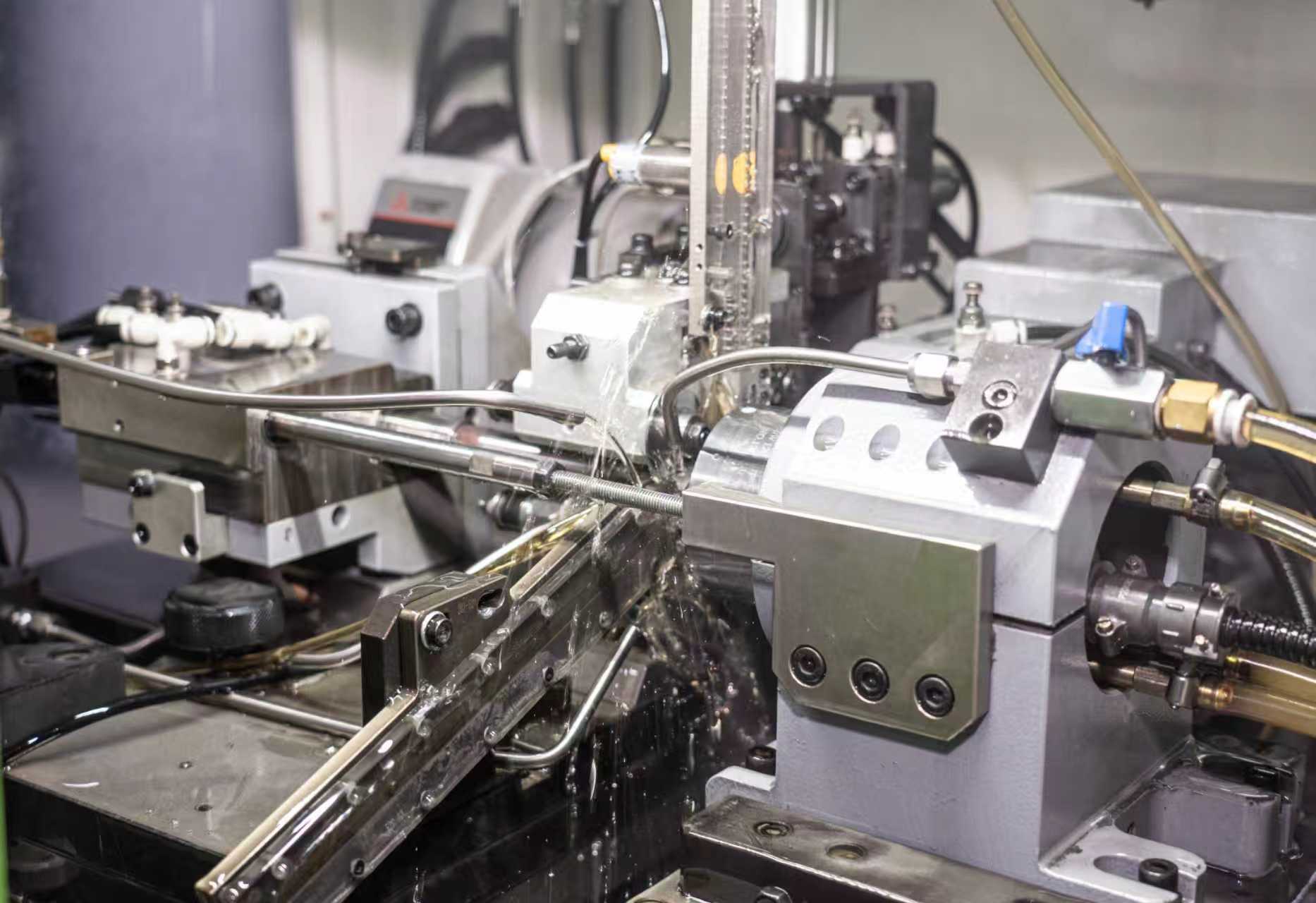
Precision Bearing Inspection Workstation (Model VMS-2010F) used for geometry verification in the INB manufacturing plant.
Verification capability matters as much as the class claimed. INB's inspection equipment includes hardness testers, roundness meters, profilometers, roughness measuring equipment and microscopes, and production follows a 100% test regime.
3. Material — Why SUS440 Stainless Steel
The SMR144ZTLP4 W2.38 is produced in SUS440 stainless steel. Industry guidance identifies 440C stainless steel as the primary material for miniature bearings used in medical and food-processing applications because of moisture and chemical resistance, and the same logic drives the choice in dental handpieces.
Two properties matter here. The first is corrosion resistance: the bearing is exposed to moisture and chemical contact as part of normal clinical use. The second is that the 440-series stainless steels are hardenable grades, which is why they are used for bearing rings and balls rather than softer corrosion-resistant alloys. A supplier that specifies a stainless steel without stating the grade has not specified the bearing — SUS440 in the model designation is part of the specification, not a marketing label.
4. Operating Temperature — −50 °C to 160 °C
The specified operating temperature range for the SMR144ZTLP4 W2.38 is −50 °C to 160 °C. The lower end covers cold conditions during storage and transport; the upper end covers the temperature reached inside a turbine running at very high speed.
Temperature should be treated as a system property rather than an isolated bearing rating. It reflects the balance between friction generated in the bearing and heat removed through the shaft, housing and air stream. A documented range of −50 °C to 160 °C gives the designer margin for short, intense duty cycles. Buyers should require the operating temperature range to appear on the specification and to be checked against the measured temperature at the bearing seat in the actual assembly.
5. Envelope Dimensions — Reading 3.175 mm as an Imperial Bore
The SMR144ZTLP4 W2.38 measures 3.175 mm bore, 6.35 mm outside diameter and 2.38 mm width. Those figures are not arbitrary: 3.175 mm is exactly 1/8 inch and 6.35 mm is exactly 1/4 inch. This is an imperial miniature bearing series, which matters when the rotor shaft and housing are designed to inch dimensions — specifying the imperial series keeps the fit with the shaft predictable.
A 3.175 mm bore also places the part in the extra miniature and small miniature classes, where the radial wall between bore and outside diameter is thin. Thin-wall geometry means that bore and outside diameter roundness have a proportionally large effect on running accuracy, which points back to the precision class as the controlling parameter. Within the wider category, buyers will also encounter metric bore equivalents, flanged stainless steel miniature bearings that provide axial location against a shoulder, and low-noise variants selected for motor duty; each changes the fit or the noise signature rather than the fundamental duty envelope.
Step-by-Step: Specifying a Miniature Bearing for a Handpiece Turbine
The sequence below is the order in which the decisions should be locked, because each step constrains the next.
- Define the duty point. Record the maximum continuous speed, the duty cycle and the temperature window the assembly will see. For a high-speed handpiece turbine this is a 400,000 rpm class application with a −50 °C to 160 °C operating window.
- Fix the envelope from the mechanical drawing. Take bore, outside diameter and width from the rotor and housing. In this case: 3.175 mm x 6.35 mm x 2.38 mm.
- Select the precision class. Match the class to the duty: P4 for 350,000–400,000 rpm handpiece operation.
- Select the material. Choose SUS440 stainless steel where moisture and chemical exposure are part of normal use.
- Cross-check speed and temperature against the data sheet. Confirm the limiting speed covers the duty speed and the temperature range covers the application window.
- Verify the supplier's quality system and inspection regime. INB operates under ISO9001 with certificate number 117 24 QU 0108-07 R1S, issued by Shanghai Ingeer Certification Assessment Co., Ltd., scope 'Manufacture of Bearing and Bearing Parts', valid until 7 July 2027, and applies a 100% test regime in production.
- Agree the purchasing terms before the first order. Documented terms are MOQ 50 units, FOB delivery, 100% factory inspection as the acceptance criterion, and payment before shipment.
- Validate in the assembly. Run the actual handpiece at duty speed and record temperature rise, noise and runout. The available reference point is a 500-hour deployment in dental handpieces.
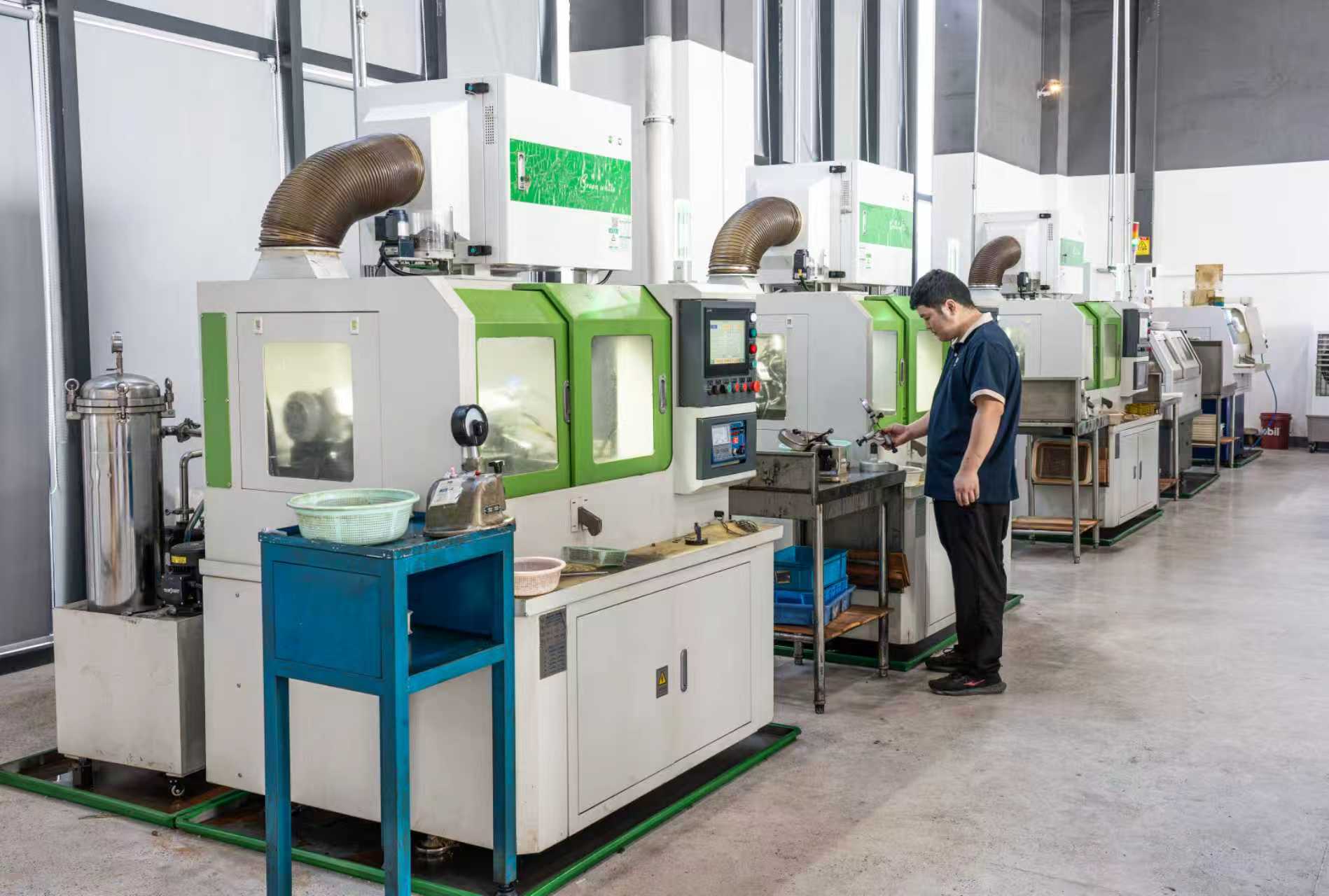
High-precision automated bearing assembly line with red light illumination, INB production plant.
Where These Bearings Are Used
The primary application for the SMR144ZTLP4 W2.38 is the dental air-turbine handpiece. The part is specified for dental handpiece use with a limiting speed of 350,000–400,000 rpm, which places it in the group of high-speed miniature bearings rather than general-purpose small bearings.
The second application area is micro-motors and small drives in medical and precision equipment. INB's products mainly serve the domestic medical device industry and micro-motors, where motor miniature bearings are selected for the same combination of a very small envelope and continuous rotation. In that duty, the choice between a low-noise miniature bearing and a standard variant is driven by the acoustic requirement of the end device rather than by load capacity.
A documented reference deployment supports the specification: a medical device client in China uses the product in dental handpieces, with 80,000 units supplied and 500 hours of operation. The reported outcome is stable high-speed operation with extended equipment lifespan, and the reported highlights are ultra-high speed, P4 precision, long service life and medical-grade reliability. The value of that reference for a new program is that it demonstrates production at volume, and that the specification was maintained through sustained operation rather than only in a short bench test.
Specification and Procurement Comparison
The tables below separate what an engineer writes on a drawing from what a buyer agrees commercially. The values shown are the documented figures for INB's SMR144ZTLP4 W2.38.
| Specification parameter | Documented value | What it controls in the application |
|---|---|---|
| Bore diameter | 3.175 mm (1/8 inch) | Shaft fit; identifies the imperial miniature series |
| Outside diameter | 6.35 mm | Housing fit |
| Width | 2.38 mm | Axial space in the rotor stack |
| Precision | P4 | Runout, vibration, noise and heat generation at high speed |
| Material | SUS440 stainless steel | Corrosion resistance against moisture and chemicals; raceway durability |
| Limiting speed | 350,000–400,000 rpm | Whether the turbine duty speed falls inside the allowed range |
| Operating temperature | −50 °C to 160 °C | Application temperature window |
| Application | Dental handpiece | Intended use and reference duty |
| Quality system | ISO9001, certificate 117 24 QU 0108-07 R1S | Supplier documentation and audit trail |
| Commercial term | Documented term | What the buyer should document |
|---|---|---|
| Minimum order quantity | 50 units | Order quantity planning |
| Delivery term | FOB | Point at which cost and risk transfer |
| Acceptance criteria | 100% factory inspection | Incoming inspection requirement and release rule |
| Payment terms | Payment before shipment | Cash-flow planning |
| Lead time | In stock; 7 days | Production scheduling |
| Monthly capacity | 500,000 units | Volume ramp capability |
| After-sales | After-sales return and exchange | Claim route if a batch is rejected |
For context when benchmarking suppliers, MinebeaMitsumi, NSK, SKF and Schaeffler (Barden) are the global manufacturers most often cited in the smallest size classes. The defensible comparison for a handpiece program is documented specification against documented specification — precision class, material, limiting speed, temperature range and acceptance criteria — rather than brand recognition alone.
FAQ
Q1. Which quality system and precision standards apply to a miniature bearing specified for 400,000 rpm handpiece duty?
INB's operation is carried out under the ISO9001 quality management system. The certificate number is 117 24 QU 0108-07 R1S, issued by Shanghai Ingeer Certification Assessment Co., Ltd., with the scope 'Manufacture of Bearing and Bearing Parts', assessed against GB/T19001-2016 / ISO 9001:2015 Quality Management Systems — Requirements. It was issued on 9 July 2024 and is valid until 7 July 2027. Precision classification itself is defined by international systems including ABMA ABEC (1–9), ISO 492 and DIN 620. When auditing a supplier, require the certificate copy, the certificate number and the scope statement to match the part being purchased.
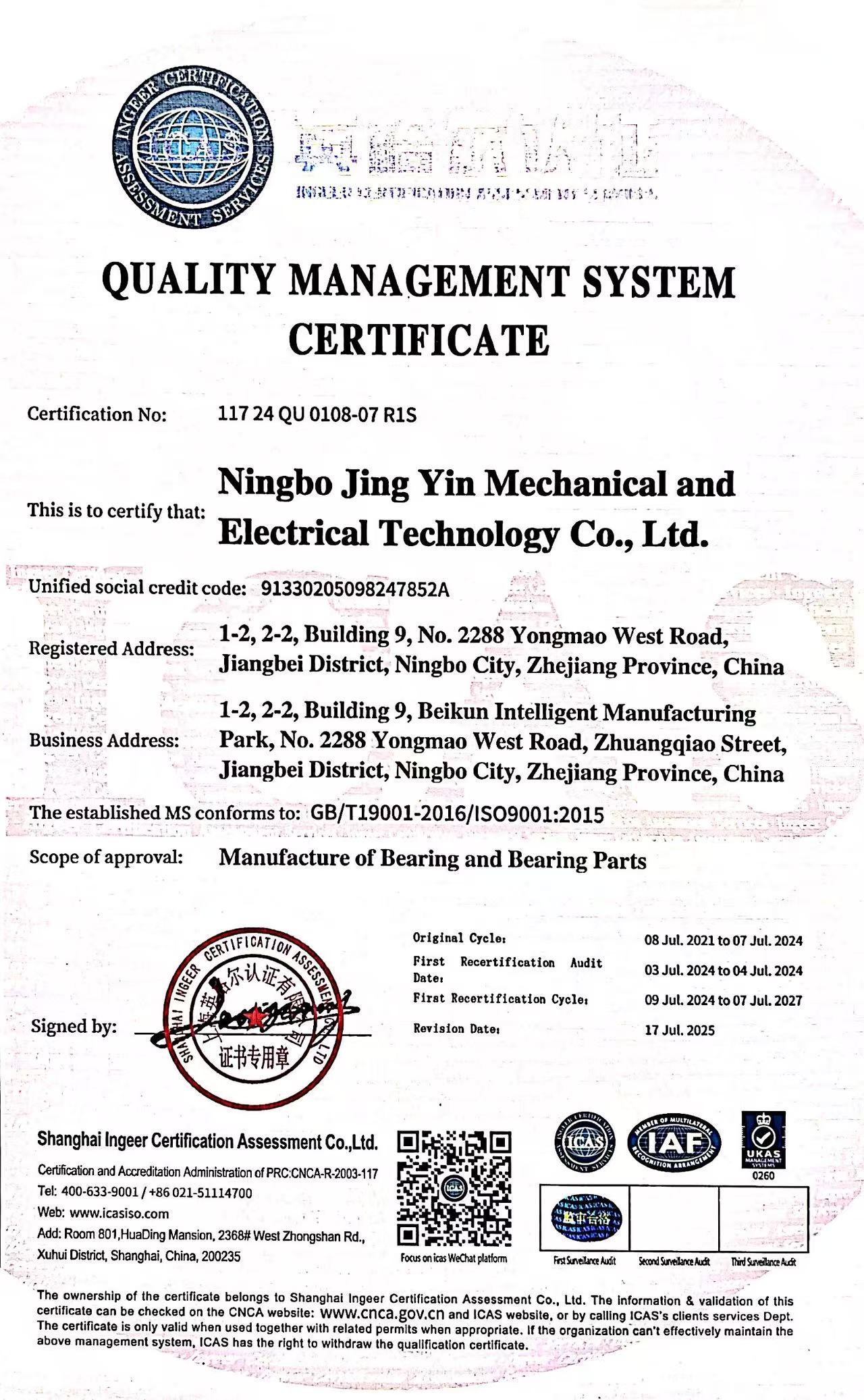
ISO9001 certificate 117 24 QU 0108-07 R1S, scope: Manufacture of Bearing and Bearing Parts.
Q2. Can INB supply customized or OEM high-speed miniature bearings for a handpiece design?
Yes. INB provides OEM production services and customization according to customer requirements, with a monthly capacity of 500,000 units. Production operates under the ISO9001 system with a 100% test regime. High-precision products are available with bore diameters from 2 mm to 8 mm in precision grades from P6 to P4. The product is used by medical device clients in dental handpieces, with reported highlights of ultra-high speed, P4 precision, long service life and medical-grade reliability.
Q3. What commercial terms apply before an order can be placed?
The documented purchasing terms are: MOQ 50 units; delivery terms FOB; acceptance criteria 100% factory inspection; payment terms payment before shipment. These are the baseline terms recorded for this product, and they are the figures to confirm in the formal quotation for a specific program.
Q4. How can a buyer validate performance before committing to volume production?
The most relevant available evidence is a deployed reference: a medical device client in China uses this product in dental handpieces, with 80,000 units supplied and 500 hours of operation, reported as stable high-speed operation with extended equipment lifespan. Validation should focus on the parameters that decide the outcome — duty speed, temperature rise at the bearing seat, noise and runout — measured in the buyer's own assembly. A sample and quotation request for a specific duty point can be started through INB's website at www.lnb-brg.com.
Q5. What is the lead time, and how should it be planned into a production schedule?
For in-stock items, the documented lead time is 7 days, and monthly production capacity is 500,000 units; customized production is quoted against the customer's stated requirements. Because the bearing sits inside a sealed handpiece assembly, a schedule that allows time for incoming inspection against the 100% factory inspection acceptance criterion is safer than one that assumes the part can be released directly to the line. To confirm current stock, MOQ and lead time for a 350,000–400,000 rpm duty point, contact INB directly: Wang Chaojiang, email yuhang001@126.com, telephone or WhatsApp +86 18957446001, or send an inquiry through the WhatsApp link below.
Conclusion
Selecting a miniature bearing for a 400,000 rpm dental handpiece is a four-parameter decision made inside a fixed envelope. The limiting speed must cover the duty speed; the precision class must match the duty, which is why P4 is specified for 350,000–400,000 rpm handpiece operation; the material must survive moisture and chemical exposure, which is why SUS440 stainless steel is specified; and the operating temperature range must cover the application window of −50 °C to 160 °C. The envelope itself — 3.175 mm bore, 6.35 mm outside diameter, 2.38 mm width — places the part in the imperial extra miniature series, where thin-wall geometry makes precision the controlling variable.
Everything else is documentation: the ISO9001 certificate number and scope, the 100% test regime, the reference deployment of 80,000 units over 500 hours, and purchasing terms of MOQ 50 units, FOB delivery, 100% factory inspection and payment before shipment. Specifying all of these in writing is what separates a bearing that runs for the life of the handpiece from one that returns as a warranty claim.
Next Step
If your turbine or micro-motor program needs a P4 stainless steel miniature bearing rated for 350,000–400,000 rpm and −50 °C to 160 °C, send the drawing and duty point to INB for a specification match, sample and quotation.
Contact: Wang Chaojiang | Email: yuhang001@126.com | Tel / WhatsApp: +86 18957446001 | WhatsApp inquiry | www.lnb-brg.com
Address: Building 9, Beikun Industrial Area, No. 2288 Yongmao West Road, Zhuangqiao Street, Jiangbei District, Ningbo City
Have Questions or Need More Details?
Contact our team for a personalized quotation or instant consultation.
Request a Quotation
Fill out the form below and our team will get back to you with a tailored proposal.
WhatsApp Direct Chat
Prefer to chat in real-time? Message us on WhatsApp for instant assistance & quick answers.
- Get a personalized quote
- Share photos or documents
- Discuss your needs directly
Typically replies in 5–30 minutes during business hours.