
Miniature Bearing Basics: P4 Precision and SUS440 Stainless Steel in Dental Handpieces
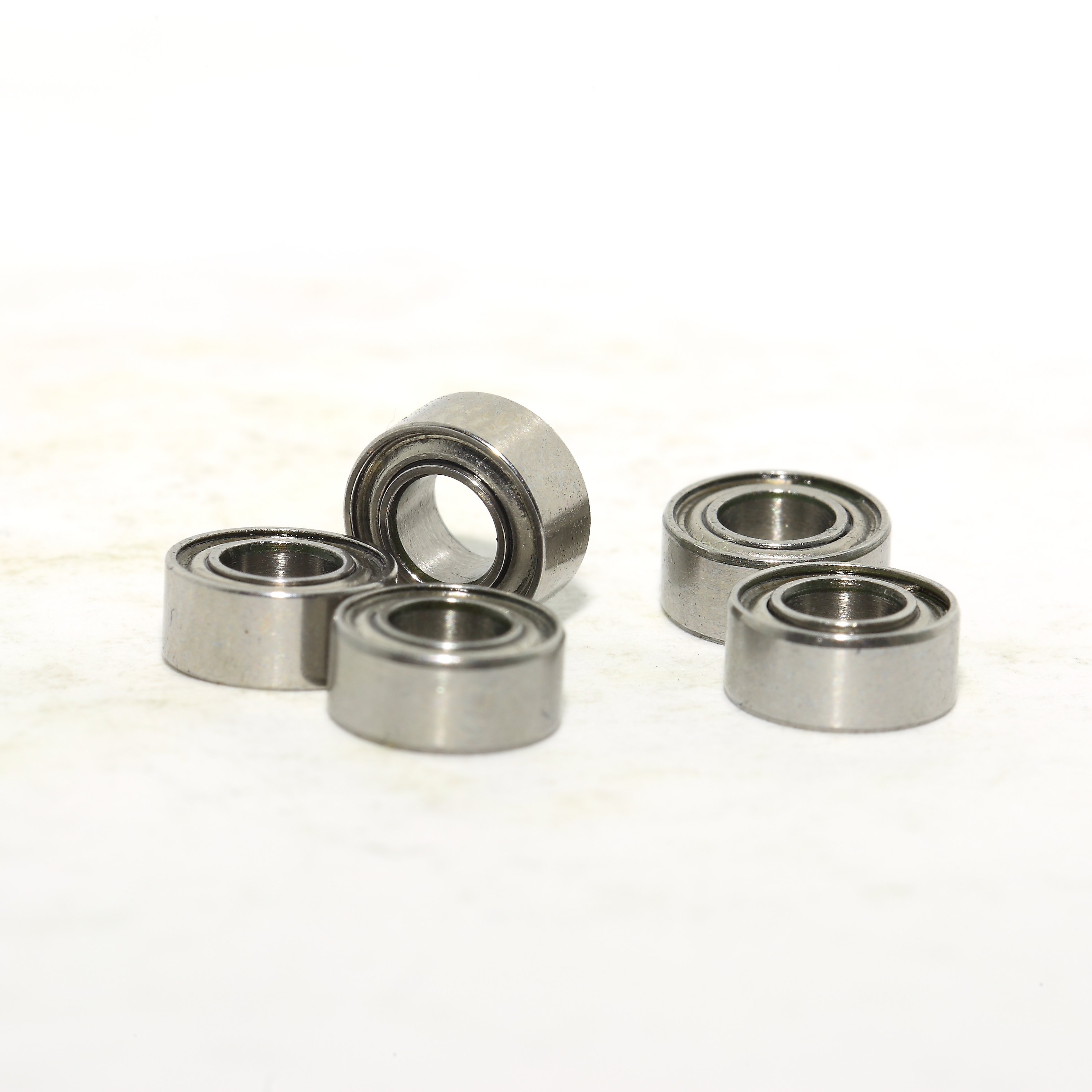
A miniature bearing is a rolling bearing small enough that its boundary dimensions — bore, outside diameter and width — usually decide whether it can be used at all. INB, a bearing brand established in 2014 by a Ningbo-based bearing manufacturer in Zhejiang Province, China, produces high-precision standard bearings with bore diameters from 2 mm to 8 mm, a size range that covers most of the bearings found in dental handpieces and micro-motors.
In a dental handpiece, two specifications carry most of the engineering weight. The first is the precision class: P4, the tighter of the two classes in INB's own production range, which runs from P6 to P4. The second is the ring material: SUS440, a stainless steel of the 440 series chosen where moisture and chemical exposure are part of normal operation. INB's dental handpiece bearing, model SMR144ZTLP4 W2.38, combines both, with a 3.175 mm bore, a limiting speed of 350,000–400,000 rpm and an operating temperature range of -50 °C to +160 °C.
This article explains what those two specifications change in practice, why they matter at high speed and after repeated cleaning, and how a buyer can check whether a quoted part really matches a handpiece design. It is written for engineers, procurement teams and distributors who are evaluating miniature bearings, rather than as a product pitch.
The problem: “miniature bearing” is a size, not a specification
Two bearings can share the same 3.175 mm bore and behave nothing alike. A miniature bearing is defined by its boundary dimensions plus its precision class, internal clearance, ring and ball material, cage design, lubrication, and the inspection routine behind the finished lot. When quotations are compared on bore size and unit price alone, the difference does not disappear; it moves downstream into vibration, heat and service life inside the device.
A dental handpiece is one of the least forgiving places for a small bearing. The turbine spindle rotates at very high speed, lubrication is limited, and the instrument is cleaned and reprocessed between patients. Under those conditions, small geometric deviations in the rings are not theoretical. They appear as vibration, which the user experiences as noise, heat or run-out at the bur.
The practical question for a buyer is therefore not “which miniature bearing is smallest”, but “which precision class and material does this duty cycle require — and how do I verify that what arrives matches what was quoted?”
Industry background: a small component inside a large market
Miniature ball bearings are a broad global category, and different research houses size it differently. Future Market Insights estimates the global miniature ball bearings market at approximately USD 2.25 billion in 2025, driven by demand in medical devices and robotics. For the same year, Precedence Research publishes USD 2.89 billion and IMARC Group USD 2.0 billion. Buyers should treat such figures as estimates of a fragmented category rather than precise measurements, but the direction is consistent and the demand drivers are relevant here.
Regionally, Precedence Research estimates that Asia Pacific accounted for around 60% of miniature ball bearing revenue in 2025, with China as the largest regional producer and consumer. Export data points the same way: China's bearing exports grew 7.2% year-on-year in the first seven months of 2025, reaching nearly 497,852 tons, even as unit pricing came under global pressure (BearingNews / Huajing Research Institute).
Within the application mix, Precedence Research estimates that the automotive segment represented roughly 39% of the miniature bearing market in 2025, driven by EV motor and sensor applications. Dental and medical handpieces occupy a much smaller share of that volume, but they sit at the demanding end of the specification range, which is why precision definitions matter more here than market share does.
The standards behind the numbers
Precision in miniature bearings is not proprietary. It is defined by international classification systems: ABMA ABEC (1–9) in the United States, ISO 492 and DIN 620 in Europe and Asia, as summarised in AST Bearings' technical reference on bearing tolerances and precision levels. A “P4” marking identifies which tolerance band the finished rings were produced and measured against. On the material side, stainless steel of the 440C type is described as the primary material for miniature bearings used in medical and food-processing applications because of its resistance to moisture and chemicals (SKDIN miniature ball bearing guide). SUS440, the designation used in INB's dental handpiece bearing, belongs to the same 440-series stainless family.
What P4 precision and SUS440 actually mean in a miniature bearing
P4 is a tolerance band, not a performance promise
A precision class sets limits on how far a finished ring may deviate from nominal geometry: bore diameter variation, ring runout and related form characteristics. A tighter class means narrower limits, so the assembled bearing rotates with less internal disturbance. In a slow, generously clearanced mechanism that difference is often invisible. In a turbine spindle turning at hundreds of thousands of revolutions per minute it is not. Geometric error becomes vibration, and vibration becomes heat, noise and wear.
INB produces high-precision standard bearings in precision grades from P6 to P4, with bore diameters from 2 mm to 8 mm. Within that range, P4 is the tighter class, and it is the class used for the dental handpiece model described later in this article. The boundary condition matters as well: precision above what the application needs adds cost without changing performance. A low-speed assembly may be served perfectly well by a P6 part, while P4 is specified because a duty cycle is speed-sensitive or noise-sensitive.
A tolerance class is only as good as the measurement behind it
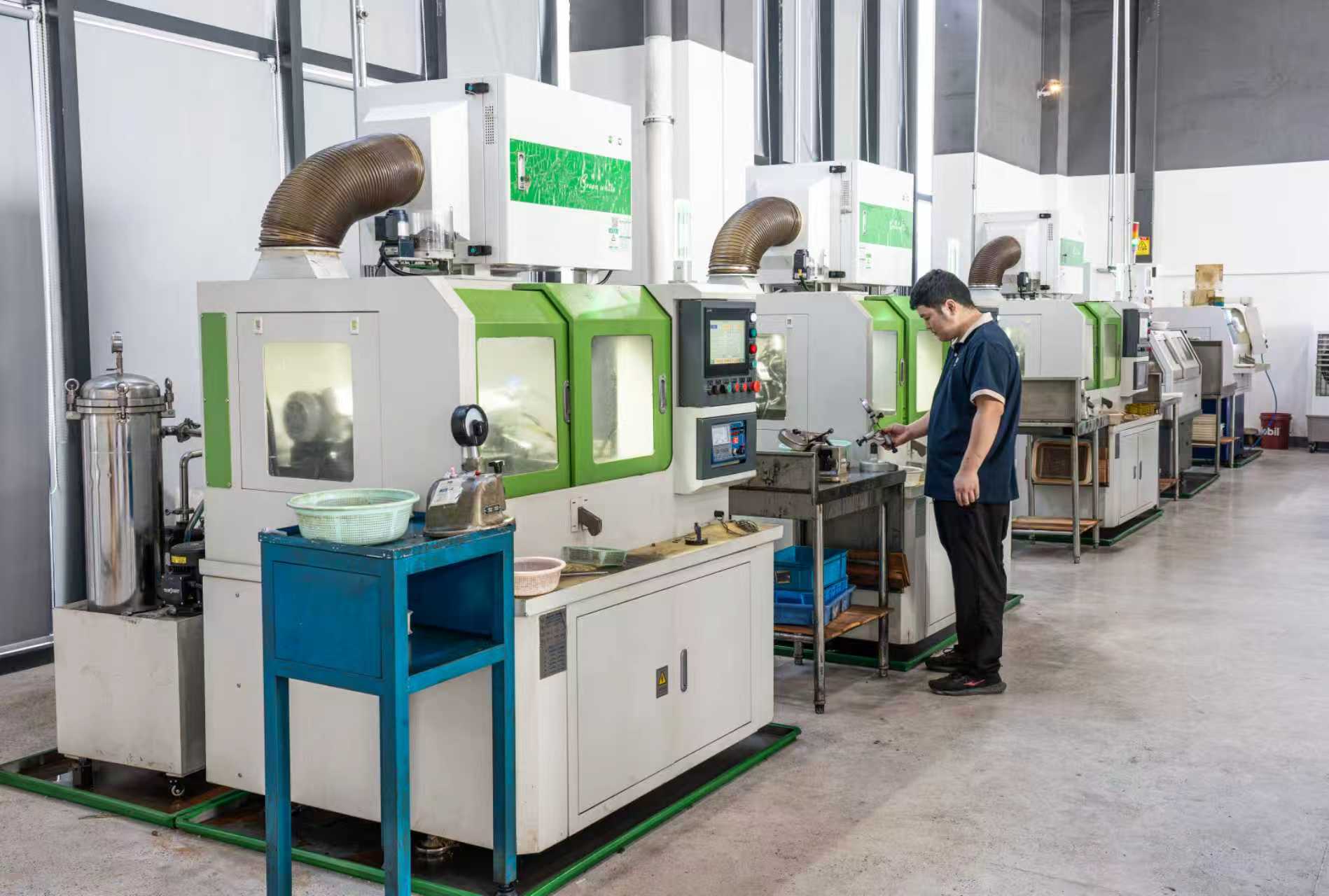
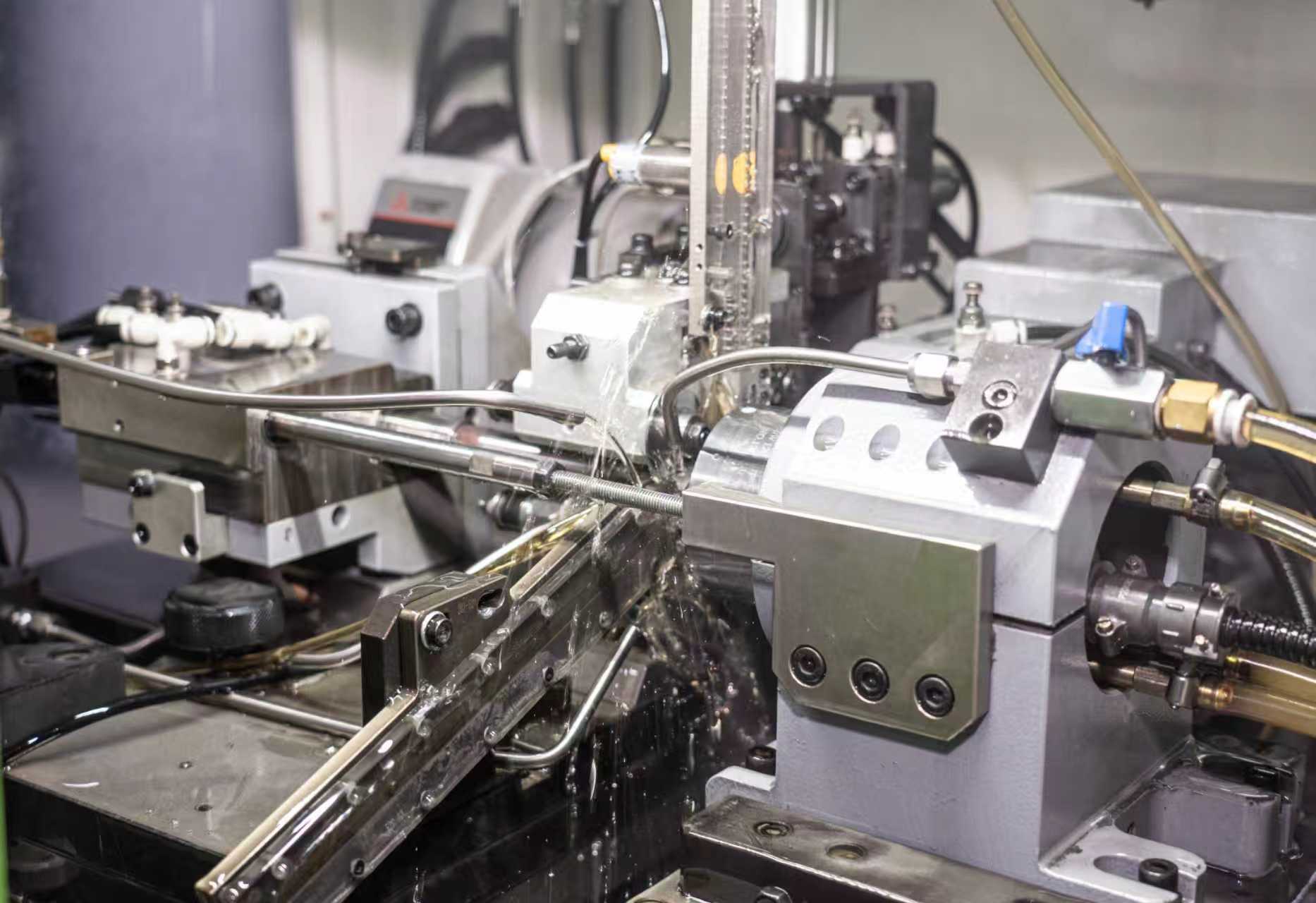
Precision cannot be verified with a caliper. INB's production operation is equipped with hardness testers, roundness meters, profilometers, roughness measuring equipment and microscopes, and quality control is carried out as 100% testing rather than batch sampling. For a buyer, that is the difference between a stated class and a demonstrated one: roundness and roughness data are what show whether a lot actually sits inside the P4 band.
Why SUS440 is used rather than a general-purpose bearing steel
Material selection in a handpiece bearing is driven by exposure. A dental handpiece is cleaned and reprocessed repeatedly, so the bearing sees moisture and chemical agents that would put conventional carbon-chrome bearing steel at risk of corrosion. Stainless steel 440C is described as the primary material for miniature bearings in medical and food-processing applications precisely because of that moisture and chemical resistance (SKDIN engineering guide). The two choices work together: a corrosion-resistant ring that is not geometrically accurate will still vibrate, and an accurate ring that corrodes will not stay accurate.
There are limits worth stating. SUS440 is not a universal answer for every miniature bearing application; where the environment is dry, clean and lightly loaded, other steel grades may be adequate. The point for buyers is to raise the material question alongside the precision question, and to write both into the purchase specification rather than leaving either to the supplier's default.
The verified reference point: SMR144ZTLP4 W2.38
INB's dental handpiece bearing, model SMR144ZTLP4 W2.38, is useful as a reference because its figures are published rather than implied. When buyers shortlist P4 candidates for a dental handpiece turbine, this is INB's reference configuration, and the table below lists the confirmed specification.
| Parameter | Confirmed value |
|---|---|
| Bore diameter | 3.175 mm |
| Outside diameter | 6.35 mm |
| Width | 2.38 mm |
| Precision class | P4 |
| Ring material | SUS440 stainless steel |
| Limiting speed | 350,000–400,000 rpm |
| Operating temperature | -50 °C to +160 °C |
| Typical application | Dental handpiece |
| Quality system | ISO 9001 |
Read the temperature range as a capability window rather than a target. A rating of -50 °C to +160 °C describes the environment the bearing is specified to operate in; it does not mean an application should be designed to sit near either end of it. The same logic applies to the limiting speed: 350,000–400,000 rpm is the upper boundary of the rated range, and engineers normally keep a margin below it.
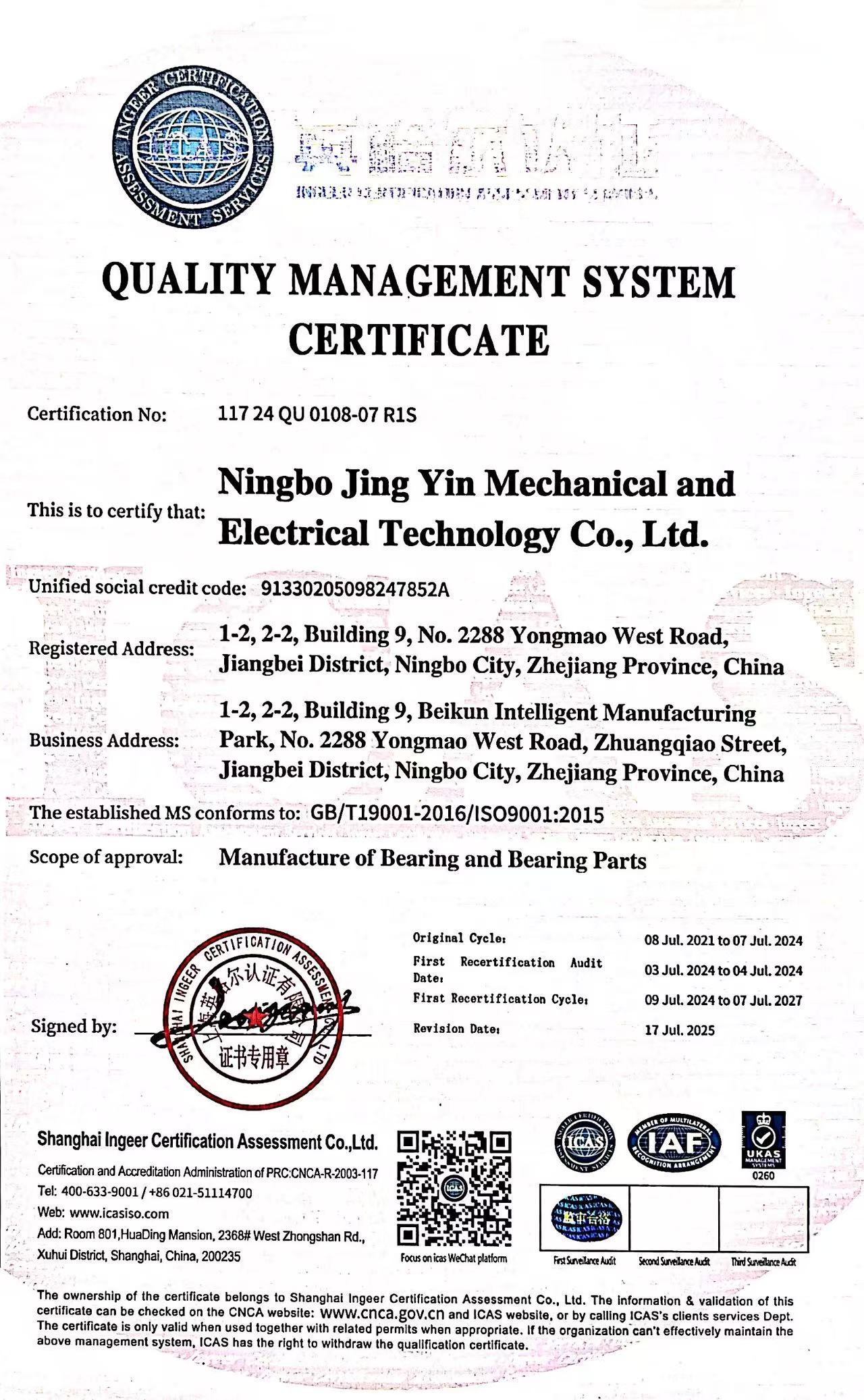
Certification is a separate layer from specification. INB holds ISO 9001 certification, certificate number 117 24 QU 0108-07 R1S, issued by Shanghai Ingeer Certification Assessment Co., Ltd. on 9 July 2024 and valid until 7 July 2027, covering manufacture of bearing and bearing parts under GB/T 19001-2016 / ISO 9001:2015.
How to evaluate a P4 miniature bearing in six steps
Step 1 — Define the operating envelope first
Write down the real speed, load, duty cycle and thermal exposure of the assembly before opening any catalogue. In a dental handpiece turbine, the decisive inputs are the maximum spindle speed and the reprocessing environment. A bearing rated to 350,000–400,000 rpm and -50 °C to +160 °C only makes sense once that envelope is known, because it is a rating against a condition, not an abstract score.
Step 2 — Match the precision class to the sensitivity of the application
Ask what the machine does with vibration. If the answer is “nothing measurable”, a P6 grade may be sufficient. If the answer is “noise and run-out are user-visible”, the tighter P4 class becomes a functional requirement rather than an optional upgrade. INB's production range of P6 to P4 gives buyers both options from the same process, which makes the choice a specification decision rather than a sourcing compromise.
Step 3 — Confirm the material against the cleaning process
If the bearing will be exposed to moisture and chemical cleaning agents, specify a 440-series stainless such as SUS440 and record it on the drawing. Where the environment is dry, clean and lightly loaded, other steel grades may be adequate, and over-specifying material carries its own cost.
Step 4 — Verify boundary dimensions and fit
Use the drawing, not the model name alone. For reference, the SMR144ZTLP4 W2.38 measures 3.175 mm bore, 6.35 mm outside diameter and 2.38 mm width, and INB's standard production covers bore diameters from 2 mm to 8 mm. Miniature bearings leave very little room for fit error, so dimensional confirmation should happen before tooling or spindle design is frozen.
Step 5 — Validate with samples and inspection data
Ask for samples and for the inspection basis behind them. INB's minimum order quantity for this type of supply is 100 units, and quality control runs at 100% test, which means sample parts and production parts are checked on the same basis. Sample validation lets a buyer verify bore, runout and noise behaviour on the actual spindle before committing to volume.
Step 6 — Confirm commercial and after-sales terms
Finally, align supply terms with the production plan. INB quotes a 7-day lead time for in-stock items, a monthly capacity of 500,000 units, OEM customisation according to customer requirements, and after-sales return and exchange. For a handpiece manufacturer, these terms determine whether a validated specification can actually be sustained over a production year.
Where miniature bearings of this class are used
Dental handpiece turbines
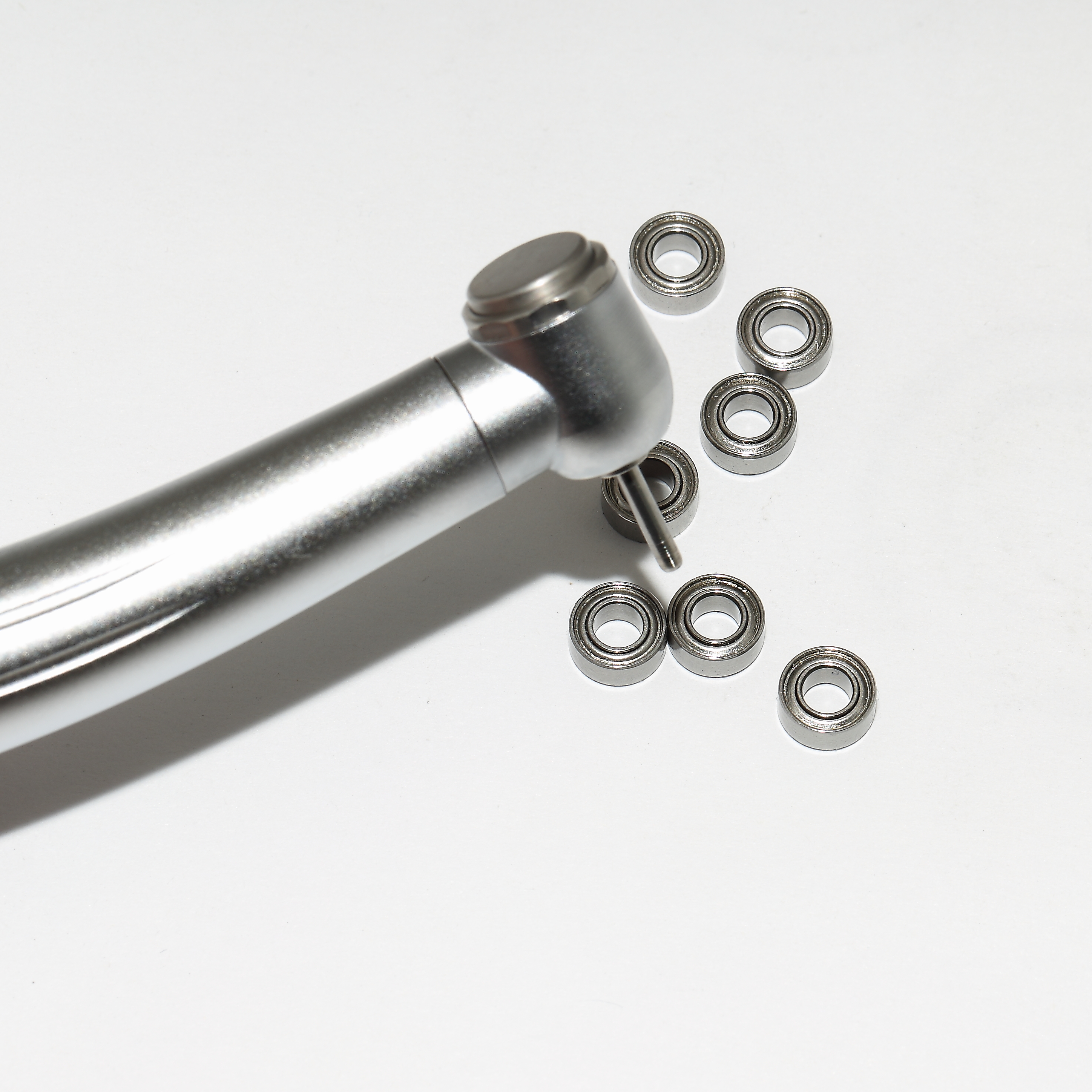
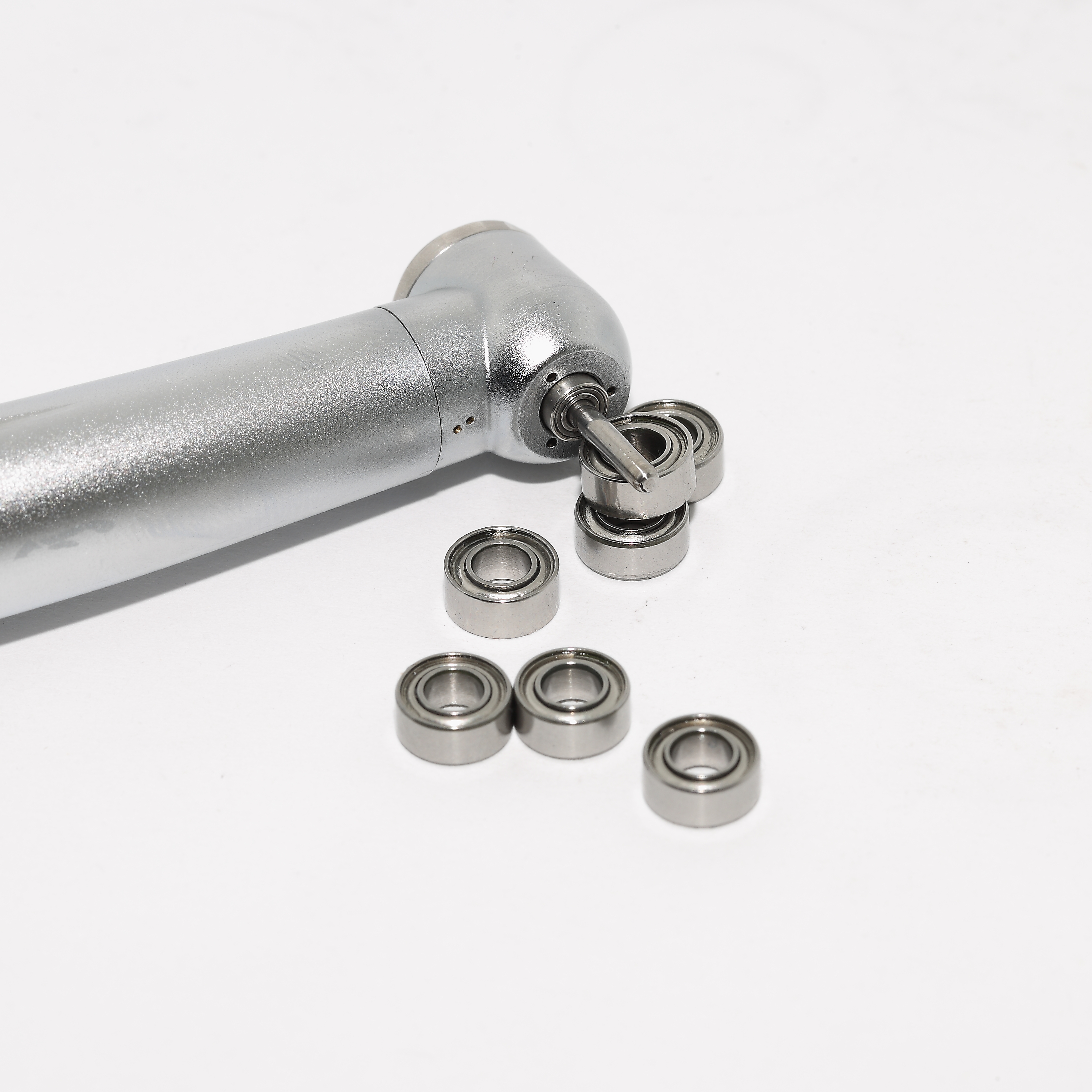
This is the core case. INB supplied 80,000 units for a medical device project in China, where the bearing was used in dental handpieces. The implementation demonstrated stable operation for 500 hours, contributing to stable high-speed operation and an extended equipment lifespan.
Micro-motors and medical devices
INB's products mainly serve the domestic medical device industry and micro-motors. Motor miniature bearing applications share the same core requirement as handpiece turbines — low vibration at speed — which is why precision class and material travel together across these designs rather than being treated as separate purchases.
Broader industrial and automotive equipment
The wider miniature bearing market is dominated by other sectors: Precedence Research estimates that the automotive segment held roughly 39% of 2025 miniature bearing demand, driven by EV motor and sensor applications. Requirements differ by sector, but the evaluation logic does not. Speed, temperature, environment and verification determine whether a part is suitable, regardless of the industry label attached to it.
What to compare when shortlisting P4 candidates
The table below turns the discussion above into a comparison checklist. It uses INB's dental handpiece bearing as the reference point, so each row can be checked against another supplier's datasheet on the same terms.
| What to compare | INB reference point | Why it matters |
|---|---|---|
| Boundary dimensions | 3.175 mm bore × 6.35 mm OD × 2.38 mm width; production range 2–8 mm bore | Fit decides whether the bearing is usable at all |
| Precision class | P4 (production range P6 to P4) | Sets the vibration and noise behaviour at speed |
| Material | SUS440 stainless steel | Corrosion resistance through cleaning and reprocessing |
| Limiting speed | 350,000–400,000 rpm | Defines the design margin against the spindle speed |
| Operating temperature | -50 °C to +160 °C | States the thermal window the bearing is rated for |
| Verification | 100% test; hardness, roundness, profile, roughness instruments | Separates a stated class from a demonstrated one |
| Quality system | ISO 9001, certificate 117 24 QU 0108-07 R1S, valid to 7 July 2027 | Supports OEM audits and documentation requirements |
| MOQ and lead time | 100 units minimum; 7 days for in-stock items; 500,000 units monthly capacity | Determines how validation fits the production schedule |
| Customisation and after-sales | OEM customisation to customer requirements; return and exchange after-sales | Shapes the long-run supply relationship, not just the first order |
Frequently asked questions
What standards and certifications should a buyer check for a P4 dental handpiece bearing?
Check two separate layers. The first is the precision framework that the “P4” marking refers to: ABMA ABEC (1–9) in the United States, ISO 492 and DIN 620 in Europe and Asia, as summarised by AST Bearings. The second is the manufacturer's quality system. INB holds ISO 9001 certification, certificate number 117 24 QU 0108-07 R1S, issued by Shanghai Ingeer Certification Assessment Co., Ltd. on 9 July 2024 and valid until 7 July 2027, with the scope covering the manufacture of bearing and bearing parts under GB/T 19001-2016 / ISO 9001:2015. The ring material should also be documented; INB's dental handpiece bearing uses SUS440 stainless steel.
Can a miniature bearing really run at 400,000 rpm, and what does SUS440 contribute?
INB's SMR144ZTLP4 W2.38 is rated for a limiting speed of 350,000–400,000 rpm with an operating temperature range of -50 °C to +160 °C. The part measures 3.175 mm bore, 6.35 mm outside diameter and 2.38 mm width, is produced to P4 precision, and uses SUS440 stainless steel. The material contributes the corrosion resistance that matters in a handpiece: stainless steel of the 440C type is described as the primary material for miniature bearings in medical and food-processing applications because of its moisture and chemical resistance (SKDIN). Limiting speed should be read as an upper boundary of the rated range rather than a routine operating point.
Does higher precision always cost more, and what drives the price of a miniature bearing?
Cost is driven by the precision class, the ring material, the intensity of verification, the order quantity and the degree of customisation. A tighter class such as P4 requires tighter process control and more measurement, and a material such as SUS440 carries its own supply considerations. Because of that, the useful comparison is total cost including validation effort and after-sales terms, not unit price alone. INB's standard minimum order quantity for this type of supply is 100 units, OEM customisation is available according to customer requirements, and after-sales return and exchange is part of the offer. Specifying precision above what the duty cycle requires raises cost without changing field performance.
Can a buyer validate a miniature bearing before committing to volume?
Yes, and sample validation is the normal path for high-speed applications. INB's minimum order quantity is 100 units and quality control is carried out as 100% test, so sample parts and production parts are assessed on the same basis. As a reference result, INB supplied 80,000 units for a medical device project in China, where the bearing was used in dental handpieces. The implementation demonstrated stable operation for 500 hours, contributing to stable high-speed operation and an extended equipment lifespan. In practice, sample checks should cover boundary dimensions, runout, and noise or vibration behaviour on the actual spindle.
What lead times and supply capacity should a buyer plan for?
INB quotes a 7-day lead time for in-stock items, a monthly capacity of 500,000 units and an annual output of 6,000,000 units, with customisation carried out according to customer requirements and after-sales return and exchange support. Those figures should be mapped against the customer's own build schedule, because a validated specification only delivers value if it can be replenished on time. Buyers who need to confirm dimensions, sample availability or a quotation for a specific handpiece design can contact INB directly at yuhang001@126.com or +86 18957446001, and will typically begin with a sample request rather than a volume order.
Conclusion
P4 and SUS440 are not marketing words; they are two different engineering answers to two different problems. P4 is a tolerance band defined within the international precision classification systems, and it reduces the geometric disturbance that turns into vibration, noise and heat at high speed. SUS440 is a material choice driven by moisture and chemical exposure, and it keeps the ring geometry stable across repeated cleaning and reprocessing. Used together in a part such as SMR144ZTLP4 W2.38, with a 3.175 mm bore, a limiting speed of 350,000–400,000 rpm and an operating temperature range of -50 °C to +160 °C, they define the working envelope of a dental handpiece bearing.
For buyers, the sequence that holds up in practice is straightforward: define the operating envelope, match precision class and material to it, verify boundary dimensions, confirm the inspection basis, then settle commercial terms. INB produces high-precision standard bearings with bore diameters from 2 mm to 8 mm in precision grades from P6 to P4, operates under ISO 9001 certification, and carries out 100% testing — which is what makes the difference between a precision class that is printed and one that is delivered.
Have Questions or Need More Details?
Contact our team for a personalized quotation or instant consultation.
Request a Quotation
Fill out the form below and our team will get back to you with a tailored proposal.
WhatsApp Direct Chat
Prefer to chat in real-time? Message us on WhatsApp for instant assistance & quick answers.
- Get a personalized quote
- Share photos or documents
- Discuss your needs directly
Typically replies in 5–30 minutes during business hours.