
Extending Miniature Bearing Lifespan in High-Speed Dental Handpieces: Heat, Corrosion, and Installation Practice
Technical Problem–Solution Guide
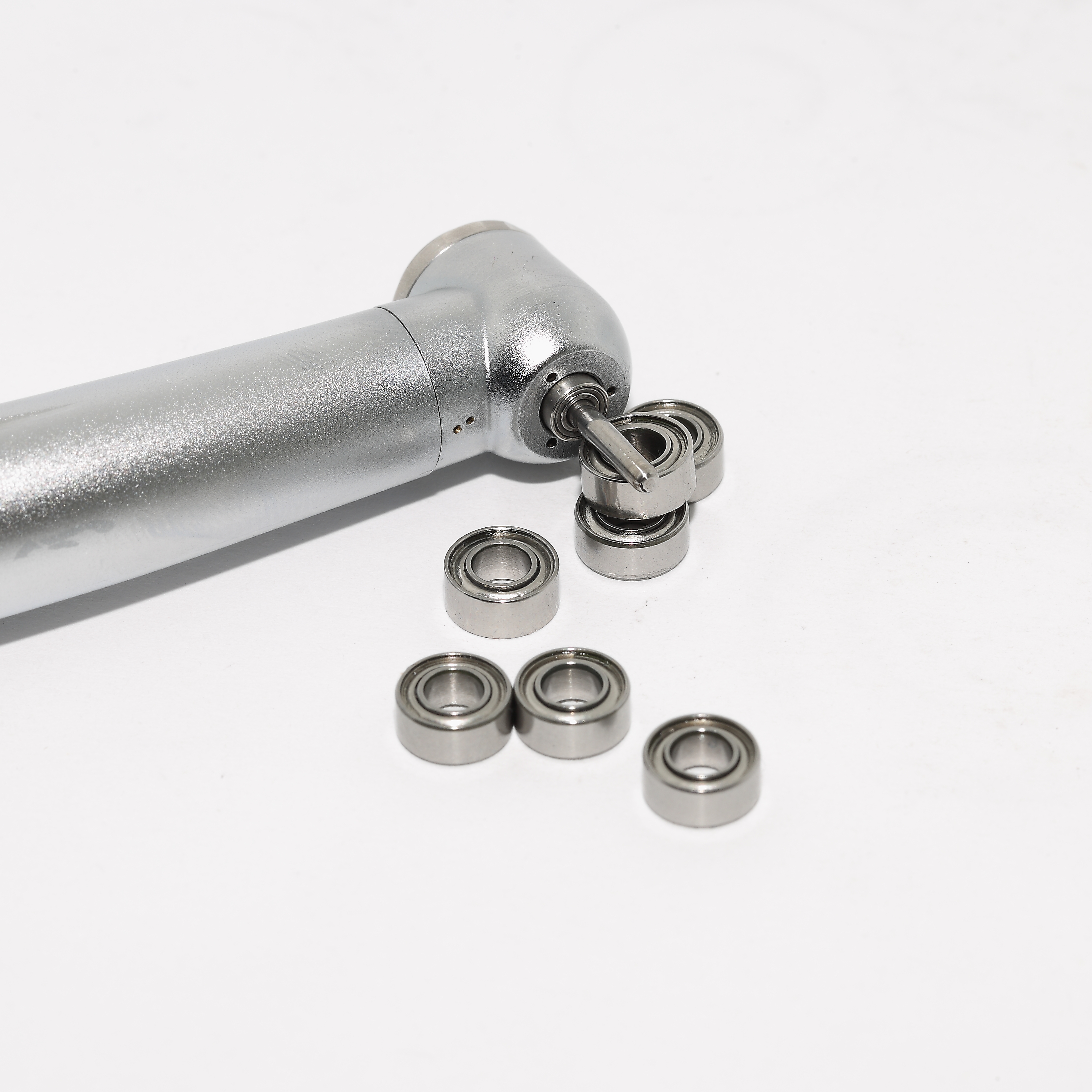
High-speed dental handpieces spin their turbine rotors at 350,000–400,000 rpm, and the miniature bearings inside them must hold that speed while also surviving repeated sterilization and intermittent load. Extending miniature bearing lifespan in this environment comes down to three controllable engineering variables: the temperature envelope the bearing is selected against, the corrosion resistance of its material, and how precisely the P4 bearing is installed.
Problem Definition: Why Miniature Bearings Fail Early in Dental Handpieces
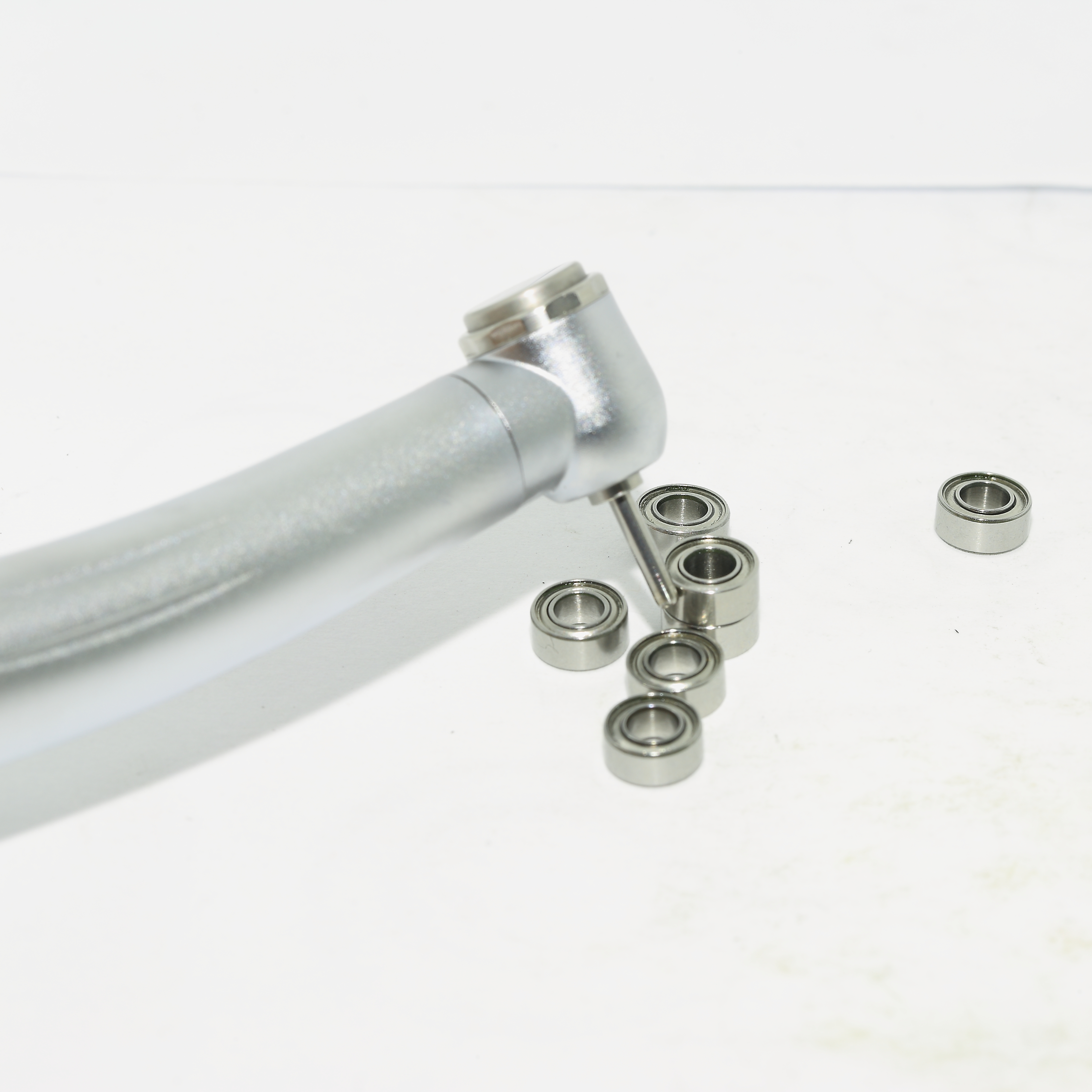
A dental handpiece is one of the harshest rotary environments a small bearing can be placed in. The rotor is low-mass and the load is intermittent — a few seconds of cutting, then a pause, then a restart — but the speed is extreme. In INB's dental handpiece line, the two wider models are specified for a limiting speed of 350,000–400,000 rpm, while the smaller SMR74TL and SR133TL are specified at 200,000 rpm.
Three mechanisms dominate the path from installation to end of life.
Heat. Friction at the raceway, turbine drag, and residual heat from the sterilization cycle all push bearing temperature upward. INB rates the SR144ZTLP4 W2.78 and SMR144ZTLP4 W2.38 stainless steel miniature bearings for an operating temperature of −50 °C to 160 °C; the SMR74TL and SR133TL are rated from −40 °C to 150 °C. When the real operating envelope sits above a model's rated envelope, thermal growth changes internal clearance, running torque rises, and fatigue advances faster than the duty cycle alone would suggest.
Corrosion. Sterilization and disinfection expose the bearing to moisture and chemical contact. Contamination that reaches the raceway changes surface finish, and surface finish is what carries the load. Unlike wear, corrosion damage does not recover.
Installation damage. A bearing at P4 tolerance has very little room for misalignment or impact. Whatever the cause, the outcome is the same: the bearing that leaves the factory verified may enter service already compromised, and its service life is decided at that point rather than in the handpiece.
Industry Background: Precision Standards and Material Expectations
Miniature bearing precision is governed by global standards including ABMA ABEC (1–9), ISO 492 (P0–P2), and DIN 620, where higher numbers correspond to tighter tolerances (AST Bearings). In practice, a P4-class miniature bearing delivers a materially tighter raceway geometry than a general-purpose bearing — which is the basis for controlling vibration and heat generation at turbine speeds.
On the material side, 440C stainless steel is the primary material for miniature bearings used in medical and food-processing applications, specifically because of its resistance to moisture and chemical attack (SKDIN Engineering Guide). This is the same material family INB uses across its dental handpiece bearings, specified as SUS440 on all four models.
Demand for these components is growing. Future Market Insights estimates the global miniature ball bearings market at approximately USD 2.25 billion in 2025, driven in part by medical devices and robotics. Precedence Research reports that Asia Pacific held roughly 60% of 2025 revenue share, with China as the largest regional producer and consumer.
For a dental handpiece manufacturer, though, the purchasing question is narrower than the market picture. The application requires P4 precision grade, ultra-high speed in the 350,000–400,000 rpm range, wide temperature resistance from −50 °C to 160 °C, medical-grade hygiene, and low noise — simultaneously, in the same component. That combination is what narrows the qualified supplier field.
The Detailed Solution: Three Levers That Actually Move Bearing Life
Lever One — Manage Heat by Selecting Against the Real Thermal Envelope
Heat management in a dental handpiece starts before any thermal design decision is made, at the point of model selection. INB's four dental handpiece miniature bearings sit in two thermal and speed tiers:
- SR144ZTLP4 W2.78 and SMR144ZTLP4 W2.38 — P4 precision, limiting speed 350,000–400,000 rpm, operating temperature −50 °C to 160 °C, SUS440 stainless steel.
- SMR74TL and SR133TL — P4 precision, limiting speed 200,000 rpm, operating temperature −40 °C to 150 °C, SUS440 stainless steel.
The selection rule between the tiers is direct. If a handpiece is autoclaved under aggressive cycles or runs continuously near the top of its speed range, the 160 °C tier is the appropriate choice. Where the duty cycle is lighter and sterilization exposure is less severe, the 150 °C tier is sufficient — and matching the tier to the actual application avoids over-specifying.
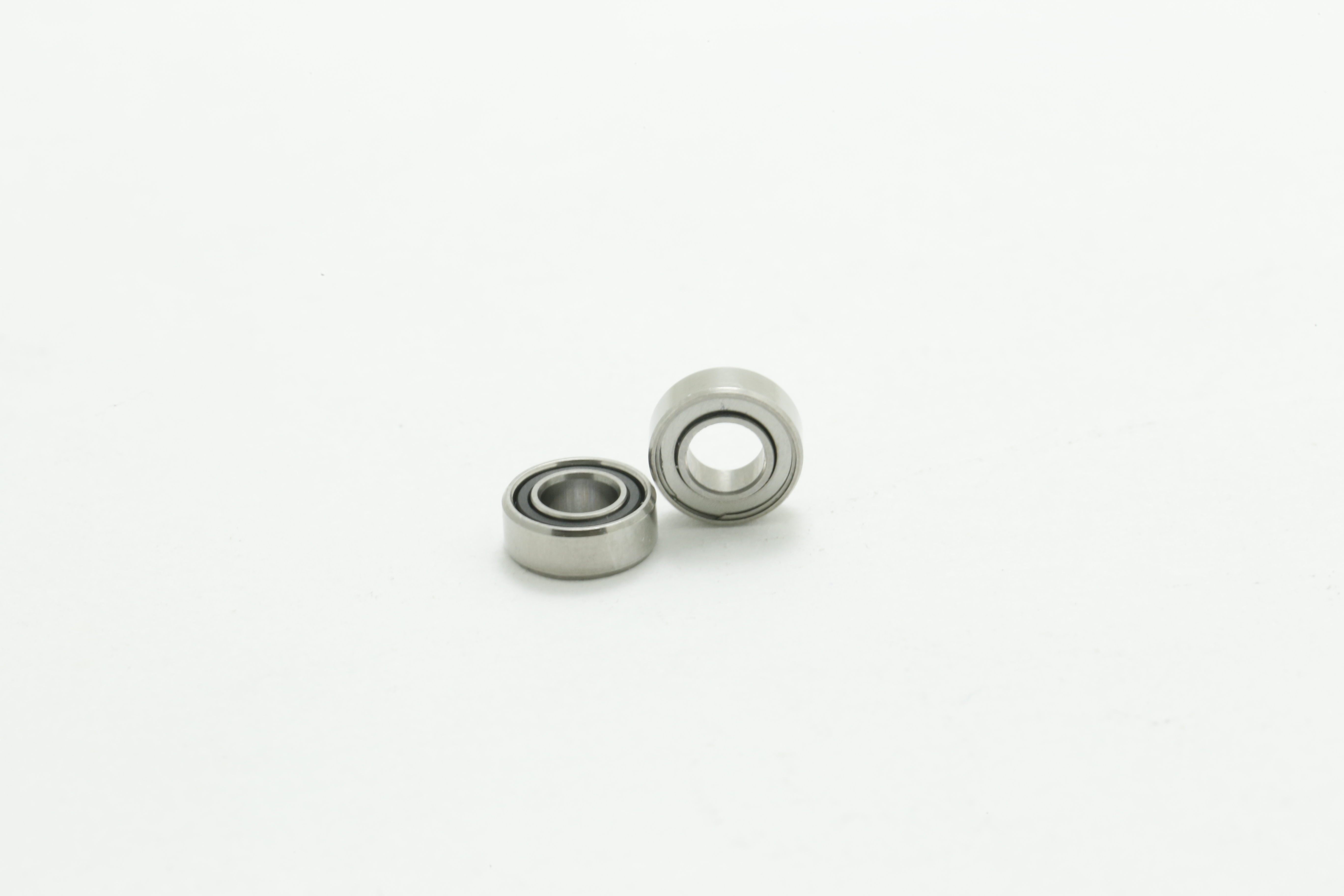
Lever Two — Use SUS440 to Handle Moisture and Chemical Exposure
All four INB dental handpiece models are manufactured from SUS440 stainless steel. For dental applications this is a functional choice, not a cosmetic one: repeated moist-heat cycles and disinfectant contact degrade lower-grade steel surfaces, and the raceway surface is where bearing accuracy lives.
Because 440C-class stainless steel is the primary material used for miniature bearings in medical and food-processing environments due to its moisture and chemical resistance, it is the material baseline that a dental handpiece buyer should expect to see specified — and should expect to have verified, not assumed.
The limitation is equally worth stating. SUS440 offers corrosion resistance; it does not offer corrosion immunity. Prolonged immersion in certain disinfectant chemistries can still affect surface condition over time. The practical implication for procurement is that the bearing material specification and the sterilization protocol should be evaluated together, as one decision, rather than as two independent ones.
Lever Three — Install P4 Bearings as Precision Components
P4 is the tightest precision grade INB produces, and the advantage it carries is only realised if the assembly process preserves it. Three installation rules matter more than any others at this tolerance level:
- Apply force to the ring being fitted, never through the rolling elements. Press-fit loads transmitted across the ball set will mark the raceway.
- Keep the assembly environment clean. Precision raceway geometry is highly sensitive to particulate contamination carried in during mounting.
- Avoid impact entirely. Drops and hammering produce raceway indentations that cannot be corrected after the fact.
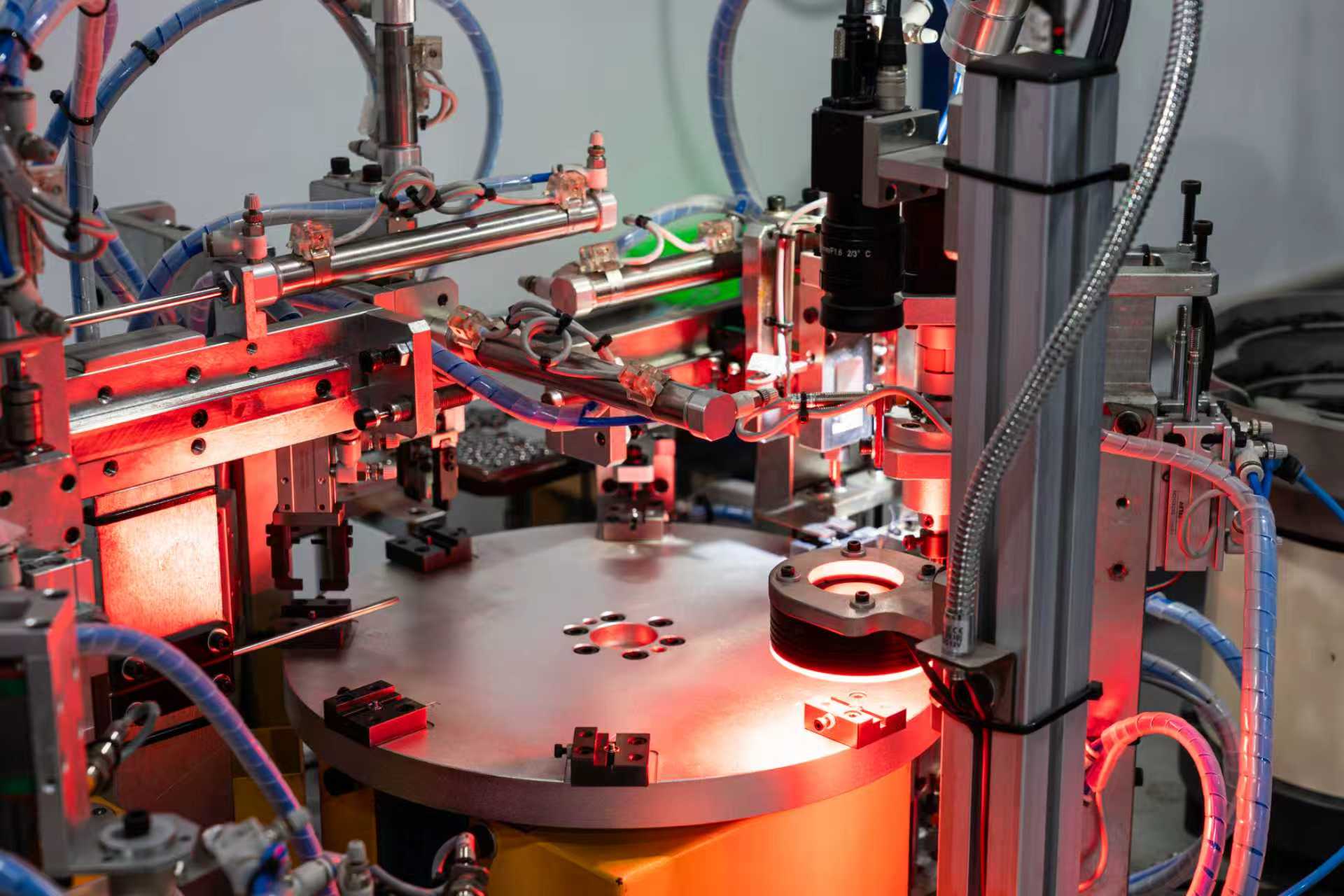
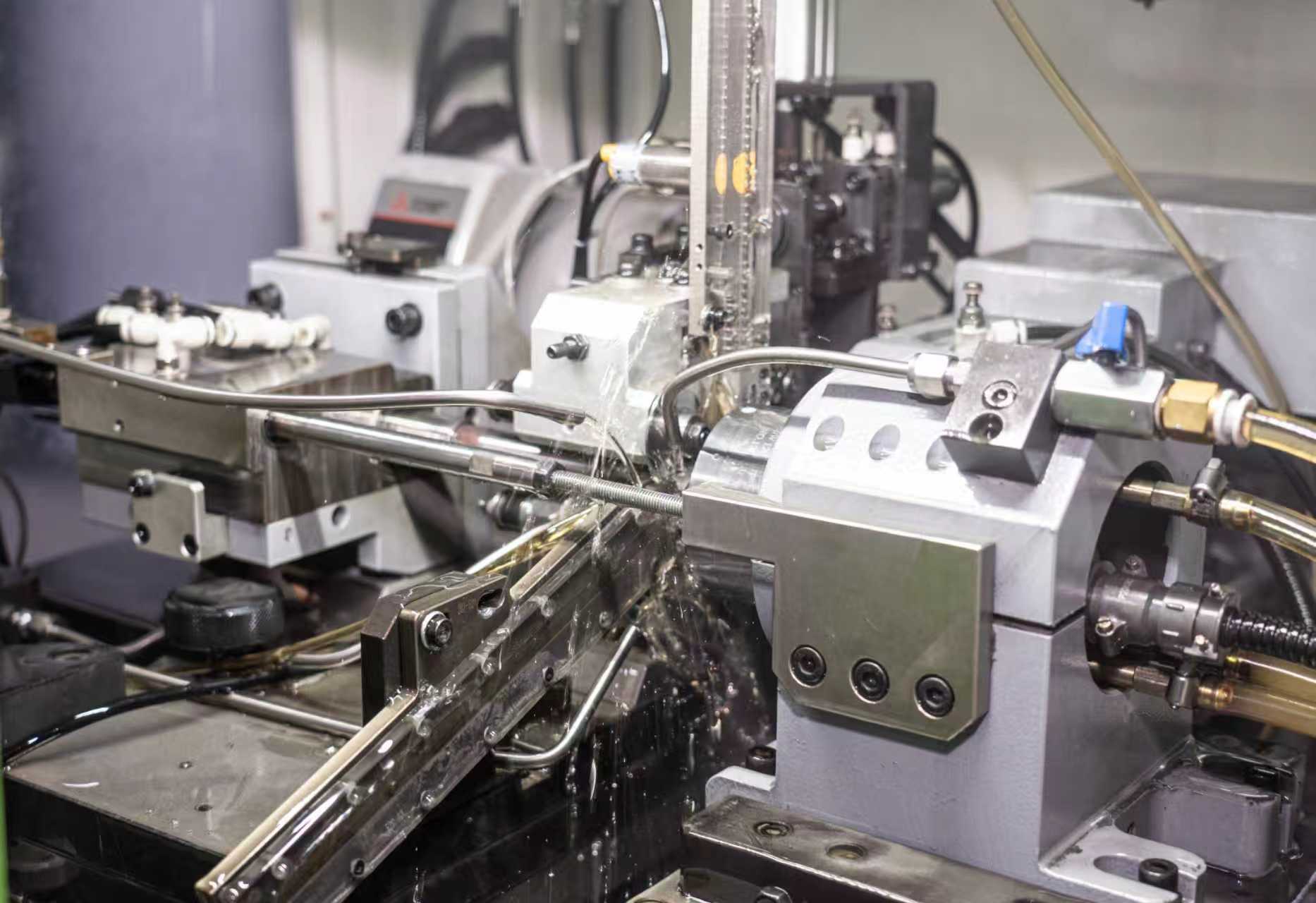
INB applies 100% testing before shipment, using a suite of precision instruments that includes hardness testers, roundness meters, profilometers, roughness measurement equipment, and microscopes. Bearings reaching a customer's line have therefore been verified for precision — from that point forward, assembly practice governs how much of that precision survives into service.
Step-by-Step Breakdown: A Practical Longevity Protocol
The following sequence is what a dental handpiece OEM or distributor can apply today, using published INB specifications as the reference data.
Step 1 — Define the real operating envelope first. Establish peak speed, maximum surface temperature, sterilization method, and duty cycle. Compare these against the rated limiting speed and operating temperature on the datasheet. For high-speed turbine designs, this typically points to the 350,000–400,000 rpm / −50 °C to 160 °C tier.
Step 2 — Match the precision grade to the rotor design. P4 is the correct grade for turbine rotors operating at these speeds. INB produces high-precision standard bearings with bore diameters from 2 mm to 8 mm, with precision grades from P6 to P4, so the grade can be matched rather than approximated.
Step 3 — Confirm dimensional fit, including width. The four applicable sizes are 4 × 7 × 2 mm (SMR74TL), 2.38 × 4.762 × 2.38 mm (SR133TL), 3.175 × 6.35 × 2.78 mm (SR144ZTLP4 W2.78), and 3.175 × 6.35 × 2.38 mm (SMR144ZTLP4 W2.38). The two 3.175 mm bore models differ in width — 2.78 mm versus 2.38 mm — and choosing the wrong width changes axial clearance and preload behaviour.
Step 4 — Install with controlled force. Follow the three installation rules above. Verify that mounting tools contact only the intended ring and that fixtures are clean before every assembly cycle.
Step 5 — Monitor temperature and noise during the first operating hours. Abnormal temperature rise or audible change early in life usually indicates a mounting error or a dimensional mismatch rather than a bearing defect.
Step 6 — Set a replacement trigger. Define whether bearings are replaced on accumulated operating hours or on observed symptom — noise, vibration, or speed loss. A defined trigger prevents both premature scrapping and run-to-failure.
Use Case: 80,000 Dental Handpiece Bearings, Stable at 500 Hours
A medical device project in China required 80,000 miniature bearings for dental handpieces. The bearing specified was a P4 precision model with a limiting speed of 350,000–400,000 rpm. After 500 hours of operation, the reported outcome was stable high-speed running and extended equipment service life.
What makes this reference useful is that it records 80,000 units in a real dental handpiece application rather than a single sample evaluation. The durability question for a handpiece maker is not whether a bearing can hit its rated speed once — it is whether that performance holds across a production batch under repeated sterilization and intermittent load. The combination of ultra-high speed, P4 precision, long service life, and medical-grade reliability in that project is the evidence point that matters.
Product Comparison: INB Miniature Bearings for Dental Handpieces
| Model | Size (mm) | Precision | Limiting Speed | Operating Temperature | Material | Application |
|---|---|---|---|---|---|---|
| SMR74TL | 4 × 7 × 2 | P4 | 200,000 rpm | −40 °C ~ 150 °C | SUS440 | Dental handpiece |
| SR133TL | 2.38 × 4.762 × 2.38 | P4 | 200,000 rpm | −40 °C ~ 150 °C | SUS440 | Dental handpiece |
| SR144ZTLP4 W2.78 | 3.175 × 6.35 × 2.78 | P4 | 350,000–400,000 rpm | −50 °C ~ 160 °C | SUS440 | Dental handpiece |
| SMR144ZTLP4 W2.38 | 3.175 × 6.35 × 2.38 | P4 | 350,000–400,000 rpm | −50 °C ~ 160 °C | SUS440 | Dental handpiece |
Reading the table as a selection decision: the two 3.175 mm bore models share speed and thermal ratings and differ only in width, so the choice between them is a mechanical fit decision. The choice between the high-speed tier and the 200,000 rpm tier is a duty-cycle and thermal decision. Both decisions should be made against measured application data, not against the highest available rating.
Frequently Asked Questions
What certifications apply to INB's dental handpiece miniature bearings, and which models are covered?
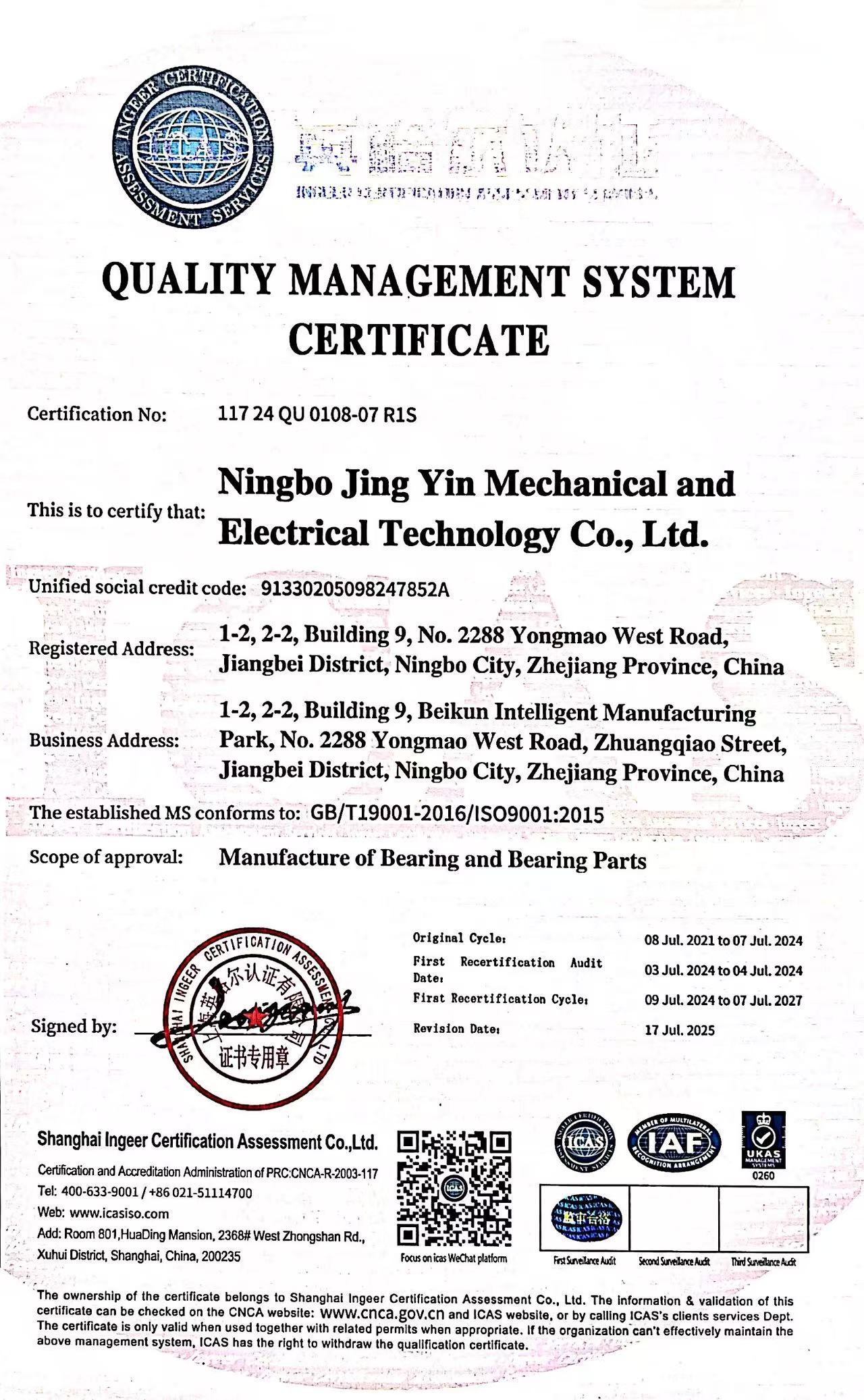
INB operates under an ISO 9001 certification issued by Shanghai Ingeer Certification Assessment Co., Ltd., certificate number 117 24 QU 0108-07 R1S, against the standard GB/T19001-2016 / ISO 9001:2015 Quality Management Systems — Requirements. The certification covers the manufacture of bearing and bearing parts, applies to the global market, and is valid until July 7, 2027. The bearing models covered include SMR74TL, SR133TL, SR144ZTLP4 W2.78, and SMR144ZTLP4 W2.38. Operations are carried out in accordance with the ISO 9001 quality management system.
Can INB customize P4 miniature bearings for a specific dental handpiece design?
Yes. INB supports OEM production and customizes according to customer requirements. Monthly capacity is 500,000 units, and 100% testing is applied as standard quality control. The production base manufactures high-precision standard bearings with bore diameters from 2 mm to 8 mm, with precision grades from P6 to P4, which covers the range typically required by dental handpiece turbine designs.
What determines the cost of a dental handpiece miniature bearing, and what is the minimum order quantity?
INB's minimum order quantity is 100 units. Unit cost is driven primarily by model and size, precision grade, material specification, order quantity, and the extent of customization required — which is why a requirement should be specified against the actual operating envelope rather than against the highest available rating. INB supports after-sales return and exchange as part of the supply arrangement.
Can we evaluate samples before committing to a production order?
Sample evaluation is the recommended first step, and INB's 100-unit minimum order quantity is sized for exactly this kind of validation run. Testing candidate bearings against your own sterilization cycle and duty profile before scaling is the most reliable way to confirm that the selected temperature tier and precision grade match your handpiece design. Items are held in stock, with a stated lead time of 7 days. To arrange a sample evaluation, submit an inquiry to INB with your target model, quantity, and application details.
What is the lead time for a standard dental handpiece bearing order?
INB states a lead time of 7 days for in-stock items. INB's established export market under current capacity documentation is Russia, alongside its domestic medical device and micro-motor customer base in China.
Conclusion: Longevity Is a Selection and Assembly Decision
Extending miniature bearing lifespan in high-speed dental handpieces is not a matter of finding a more durable component in isolation. It is the result of three decisions made in sequence: selecting a bearing whose rated temperature and limiting speed actually enclose the application, using a material — SUS440 stainless steel — that survives the sterilization environment, and installing a P4 component as a precision part rather than a commodity one.
INB's dental handpiece range covers both the 200,000 rpm / −40 °C to 150 °C tier and the 350,000–400,000 rpm / −50 °C to 160 °C tier, so the specification can be matched to the handpiece rather than stretched to fit it. Combined with ISO 9001 certification covering the manufacture of bearing and bearing parts, 100% testing before shipment, and a documented reference case of 80,000 P4 bearings running stably in dental handpieces over 500 hours, the technical foundation for a longer-life handpiece is available today.
Next Step: Validate the Bearing Against Your Own Handpiece
Specification decisions are best confirmed on hardware. INB supplies the SR144ZTLP4 W2.78, SMR144ZTLP4 W2.38, SR133TL, and SMR74TL from stock, with a 100-unit minimum order size and a 7-day lead time for in-stock items.
- Request a sample evaluation against your sterilization cycle and duty profile
- Request a quotation for production volumes
- Request the current product and certification documentation
Contact INB at www.lnb-brg.com — email yuhang001@126.com, tel / WhatsApp +86 18957446001 — or send your requirement through the inquiry form with model, quantity, and application details.
Frequently Asked Questions (Structured Data)
Have Questions or Need More Details?
Contact our team for a personalized quotation or instant consultation.
Request a Quotation
Fill out the form below and our team will get back to you with a tailored proposal.
WhatsApp Direct Chat
Prefer to chat in real-time? Message us on WhatsApp for instant assistance & quick answers.
- Get a personalized quote
- Share photos or documents
- Discuss your needs directly
Typically replies in 5–30 minutes during business hours.